"Netflix instead of Excel" - How employees trick their bosses and what managers can do about it


Working time fraud - the underestimated popular sport
While a trip to the coffee machine used to be considered a minor distraction, TikTok now openly shows how to get the maximum paycheck with minimal effort. Under the hashtag #quietquitting or #lazyworking, young employees confess that they would rather watch Netflix than answer emails - during working hours.
Want an example? A TikTok video in which someone proudly says that she is officially employed five days a week, but actually only works on Mondays, has been viewed over 400,000 times. What initially sounds like an isolated incident has long since become widespread: According to a survey conducted by Consumerfieldwork last year, 13 percent of 1,000 respondents openly admit to deliberately recording their working hours incorrectly. And: three out of four people have done something private during working hours - even though they were officially "on the job".
Where does laziness end and fraud begin?
A little chat in the office, a quick Amazon order or an Aperol during your lunch break - is that already cheating? Sascha Stowasser from the Institute for Applied Ergonomics (IFAA) sees it clearly: "Absenteeism is very expensive for companies." According to him, what many people see as minor cheating has an "enormous economic impact".
The decisive factor is that anyone who systematically does private things instead of working, or even deliberately manipulates working hours (e.g. when recording time), is clearly in breach of duty. In other words, anyone who accepts payment for work that has never been done is not only gambling with the employer's trust - but also with their own job.
How bosses can uncover whether cheating is taking place
Working time fraud is difficult to detect - especially when working from home. Nevertheless, there are a few signs that managers can look out for:
- Sudden drop in performance, although no external causes are apparent.
- Employees are often "unavailable", despite supposedly working hours.
- Inconsistencies in time recording, e.g. if working times do not match the actual output.
- A conspicuous number of sick notes or "extended" lunch breaks.
Technical tools such as digital time recording or project tracking software can help - as can regular personal exchanges. After all, if you know your employees, you will notice more quickly if something is getting out of hand.
Fraud instead of "balance"
Let's be honest: if you get paid for 5 days but only work one of them - that's not a cool life hack, it's simply stealing from the company. Even if the TikTok world celebrates this as "self-protection" or "work-life balance" - the fun stops somewhere. Companies must now take a clear stance. Not with surveillance, but with transparency, expectations and consequences. Because trust is good - but control sometimes saves sales.
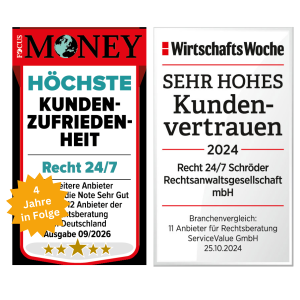
Recht 24/7 was the only online law firm to receive the Focus Money “Highest Customer Satisfaction” seal for the fourth consecutive year Recht 24/7 2023, 2024, 2025, and 2026 . The online law firm Recht 24/7 founded in 2003 with the slogan “Law can be simple” and has since helped more than 100,000 satisfied clients with all legal matters. This is also evidenced by the “Very High Customer Trust” award from WirtschaftsWoche in October 2024.
In the areas of trademark applications and start-ups, the firm filed the most applications in Germany in 2022 and 2021:
https://dev-recht24-7.de/dpma-markenanmeldung-mit-deutschlands-nummer-eins/
Optimize your team's efficiency and prevent working time fraud. Arrange a consultation with our experts now!