
Founding a non-profit GmbH online - immediately, easily and quickly

- in 24 hours
- directly from the lawyer
- all inclusive - no hidden costs
- for the fixed-price package 949.00 EURO
Establish a non-profit limited liability company at a fixed price
With Recht 24/7 , you can set up yournon-profit GmbH quickly, easily and online. Directly from a lawyer and with no hidden costs. We have been helping founders to get their company off to a legally secure and bureaucracy-free start since 2003.
Processing within 24 hours

All services for a complete and secure gGmbH company formation included
Verified TrustedShops customer reviews

It's that simple



Recht 24/7 is known from

User stories from our founders
Diadem Europe Services GmbH

Recht 24/7 provided us with excellent support and advice, even though it was not the standard procedure for a GmbH companycompany formation . No questions were left unanswered."
www.diademsports.eu
Elenita Cafe

All my questions were answered in detail and competently within 24 hours and the brand registration was completed quickly. Many thanks for the professional support!"
www.elenita-cafe.com
Black Label Coffee

"First of all, I would like to say a big thank you for the super support and the fast response time from Recht 24/7.
At the beginning, we had the founding documents drawn up by Recht 24/7 , which were accepted by the notary without any effort on our part. As time went on, we kept coming back to them with legal questions and we were always helped quickly and easily."
www.black-label-coffee.de
Signum Label Marketing UG

Recht 24/7 helped us to found our start-up without any stress."
www.ihr-private-label.de
Jellies

Recht 24/7 carried out an identity search and a similarity search for our trademark and thus showed us both risks and opportunities. The registration was completed quickly and efficiently without any problems."
www.jellieswear.com
Di-Lara

We would particularly like to emphasize the quick feedback from the Recht 24/7 team on questions and challenges during the research and application phase of our trademark trademark."
www.Di-Lara.de
Pfeiffer wooden toys

The opening of our Amazon store was one of our main reasons for filing our trademark application."
www.holzspielzeug-pfeiffer.de
Animal paradiseFB

The cooperation has proven to be very helpful and friendly."
www.tierparadiesfb.de
Your village life

Competent advice and support on various legal issues relating to the offering and sale of experiences and products on the Internet was provided from the very first minute."
www.deindorfleben.de
Flight simulator Dresden

Many thanks for the very nice contacts during our UG foundation phase."
www.flightsimulations-dresden.de
Schmiedeberger

"As a coach, I need individual legal texts that suit my work and my services. Recht 24/7 created customized legal texts for me, which I am very satisfied with.
The legal texts were created individually for me. They took the time to listen to me and create really suitable texts. 5 stars - I can recommend Recht 24/7 to anyone!"
www.lebensdreieck.de
Your advantages of founding a non-profit limited liability company online with Recht 24/7






The non-profit GmbH - the most important facts in brief
The non-profit GmbH (or gGmbH) primarily has tax advantages. Non-profit status means that the company is exempt from corporation tax, trade tax, inheritance tax or the solidarity surcharge. In addition, the gGmbH can also be exempt from VAT in the non-profit sector or benefit from a reduced tax rate of seven percent.nullThe shareholders of the gGmbH can establish the company with a share capital of EUR 12,500.00.
The advantages of the gGmbH legal form
The legal form of a gGmbH offers many advantages to the founder of a business. Firstly, the capital outlay is manageable, as only one member is required to company formation . This means that, unlike an association (at least seven!), no further co-partners are required and the formation process is much simpler than with an association. You can set up a gGmbH on your own!nullAs shown above, this legal form also offers tax advantages. These include the elimination of corporation and trade tax, which can lead to considerable savings for the company. In addition, each member is only liable to the extent of their capital contribution, i.e. they are not personally liable for the company's debts.nullFinally, another advantage of this legal form is that its name immediately conveys its non-profit status. This can be an advantage for companies that wish to issue donation receipts or accept donations from other organizations or individuals.
Non-profit business purpose of the gGmbH
The gGmbH is a non-profit business entity that operates according to the principle of selflessness. This means that all profits must be used to fulfill the charitable purpose defined in the articles of association. This purpose may include projects that benefit society, such as the provision of educational or healthcare services.nullThe main aim of this type of organization is to provide services and resources to those who need them most without expecting financial gain. The company is not allowed to accumulate assets and all profits made must be used for the charitable purpose. This ensures that resources are used for a good cause and contributes to a fairer society by providing access to essential services for those who might not otherwise have access.
Tax advantages of a gGmbH
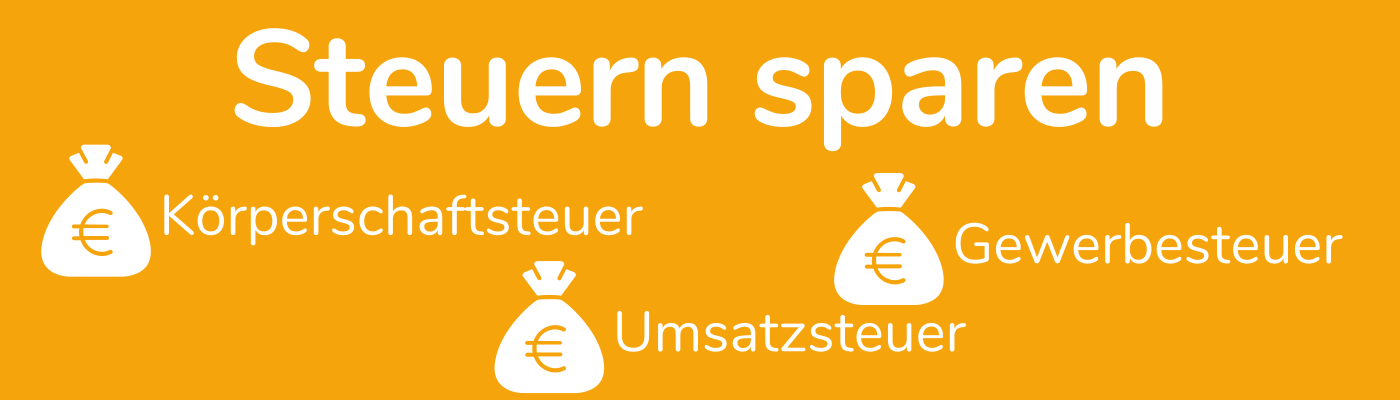 nullThe tax advantages of a gGmbH are manifold. As a non-profit organization, the gGmbH is exempt from corporation tax, trade tax and VAT. This can be a great advantage for those who want to set up a company without having to worry about the taxation of their profits.nullOverall, the tax benefits of a gGmbH are significant and should not be overlooked when considering setting up a business. The ability to avoid certain taxes can help businesses save money that would otherwise be spent on taxes and allow them to reinvest that money into their operations or other areas of their business. In addition, the reduced sales tax rate on certain sales can help businesses increase their profits while staying within legal limits.
What is the difference between gGmbH and gUG?
The main difference between the gUG and the gGmbH is the amount of share capital required for the company formation of each company. For the company formation of a gGmbH, at least EUR 12,500 must be paid into the company's bank account. In contrast, only one euro is theoretically required for the company formation of a gUG (haftungsbeschränkt). In practice, however, notaries generally require EUR 500.00 as share capital.
Alternative to the non-profit association
The e.V. is the most commonly used legal form for non-profit projects in Germany. The company formation of an association is relatively simple, but requires at least seven founding members. An alternative to this is the gGmbH (limited liability company), which can also be founded by a single person.nullOne advantage of an association over a gGmbH is that it can finance itself through membership fees. The main advantage of a gGmbH is the decision-making process, as its members are the shareholders and have more control over the decision-making process.nullIf you found alone, you decide alone! Ultimately, both forms of organization have their advantages and disadvantages and should be carefully weighed up before you decide on the right form for your project.
How does the gGmbH obtain its non-profit status?
When the company formation , the tax office checks whether the charitable principles in the articles of association have been fulfilled and whether a beneficiary organization has been designated. To ensure that all requirements are met, it is important to seek advice from a lawyer specializing in non-profit law when drawing up the articles of association.nullIn order to obtain non-profit status, it must be ensured that all principles of non-profit status are fulfilled in the articles of association and that a beneficiary organization is designated to receive the company's assets in the event of liquidation. Our experienced lawyers will provide you with comprehensive advice on all issues relating to non-profit status and structuring as part of company formation.
Our blog posts on the topic

Founding a non-profit limited liability company: What founders of a gGmbH need to know
Whether promoting art and culture or protecting historical monuments: anyone who makes a charitable purpose the main object of their company needs the right legal form. The non-profit limited liability company (short: [...]
Our experienced lawyers will advise you comprehensively on all questions of non-profit status and structuring within the framework of company formation.nullWith Recht 24/7 , you receive all services at a fixed price, no hidden costs, no packages with additional costs. Our fixed-price offer includes everything you need for the professional, smooth non-profit company formation a non-profit GmbH.
at a fixed price of 949.00 EUR net
Questions and answers on the company formation a non-profit GmbH
Recht 24/7 has been incorporating companies since 2003. We are the original and ensure that you incorporate quickly and professionally.
You will receive all the necessary documents, prepared by a lawyer according to your requirements. All within 24 hours.
Unlimited legal advice from a lawyer is included in the price. All services required for company formation are included. You pay nothing extra for legal "formation advice" or a management contract. You receive advice from a lawyer and not from a "formation consultant" without legal qualifications.
Without hidden costs. Compare for yourself.
The main difference between the two is that a gGmbH pursues a non-profit, charitable or ecclesiastical corporate purpose, whereas a GmbH primarily has commercial interests. A gGmbH must use 75 percent of its profits for the charitable purpose for which it was founded, such as animal welfare, environmental protection, consumer protection or monument conservation. A GmbH, on the other hand, is geared towards generating profits for its shareholders.nullThe decision between the company formation of a GmbH or a gGmbH therefore depends on the purpose of your company.
The e. V. is the most common legal form for non-profit projects in Germany. It requires at least seven founding members for its company formation and can finance itself through membership fees without having to build up assets. This does not make decision-making any easier, as many decisions are taken by the general meeting.nullAn alternative to the e. V. is the gGmbH, the limited liability company. This can be founded by an individual and its members are shareholders, which means that decision-making is much more centralized than with an association. It can also be made by one shareholder alone. There is no "club bureaucracy" and everything is in your hands. However, the gGmbH does not have the same access to funding as an association through membership fees and instead relies on other sources of income such as donations or grants.
The tax advantages of the company formation of a gGmbH are considerable. Once the tax office has confirmed the gGmbH's non-profit status, it receives a notice of exemption confirming tax exemption for the specified assessment period. This means that the gGmbH is exempt from corporation tax, trade tax, the solidarity surcharge and property tax. In addition, many services in the non-profit sector are exempt from VAT and taxed at a reduced rate of seven percent. In contrast, sales in commercial business operations must be taxed at a regular rate of 19 percent.
A gGmbH is a legal entity that has unlimited liability towards third parties and is obliged to pay compensation in the event of liability. This means that the gGmbH and its management are jointly and severally liable for any damage caused by the company. In addition, the management is liable without limitation for damages caused negligently or intentionally - even with their private assets.nullIt is important to ensure that all decisions are made with due care, as any negligence or willful misconduct can lead to personal financial losses for those involved in the management of the company.
One of the most common risks is that an organization does not comply with the principle of altruism, which states that it must use all profits for charitable purposes and may not distribute profits to shareholders or other persons or institutions. In addition, excessive directors' salaries and incorrect directors' contracts can also lead to violations of the principle of non-profit status.nullThe shareholders of the gGmbH should be aware of these potential pitfalls in order to avoid having their non-profit status withdrawn.
The notary fees amount to approx. 800.00 - 900.00 euros. The fee for the registry court is approx. 300.00 euros.
The non-profit limited liability company is obliged to inform the transparency register of the beneficial owner(s).nullWe would be happy to assist you with this and handle it for you. To do so, simply submit a request via the following link:https://dev-recht24-7.de/eintrag-transparenzregister/
Newsletter: Recht 24/7 Client information
Our free newsletter - directly from lawyer.
You will receive a 5% voucher code on your next order.


