Corporate objects subject to authorization


In principle, freedom of trade applies in Germany.
However, many commercial activities are subject to notification or even licensing by the competent authority. This regulation primarily serves to protect the general public. There are different regulations and authorities for business licensing.
- Trades requiring a license include the following activities:
- Towing company
- Temporary employment
- Pharmaceuticals (wholesale, import, export and production)
- Banking transactions
- Property developers and construction supervisors
- Security industry
- Loan brokerage
- Financial services
- Financial investment brokerage and fee-based financial investment advice
- Catering establishments serving alcohol
- Transportation of dangerous goods
- Real estate agent
- Passenger transportation
- Pawnbroker
- Travel trade
- Arcade
- Insurance brokerage and advice
According to § 38 GewO, there are also commercial activities that are subject to mandatory monitoring. The following activities, for example, are subject to monitoring:
- Credit agency and detective agency
- Marriage and partnership brokerage
Second-hand goods trade (high-quality consumer goods, motor vehicles
and bicycles, precious metals, precious stones, scrap metal) - Sales and installation of building security systems
- Locksmiths
- Travel agency
- Accommodation service
Section 34c of the Trade Regulation Act, which is particularly relevant for real estate agents and property developers, is examined in more detail here.
Which professional groups are covered by Section 34c of the Trade Regulation Act and what is the background to this?
Section 34c of the Trade, Commerce and Industry Regulation Act is relevant for these professions:
- Real estate agent
- Loan broker
- Property developer
- Building supervisor
- Residential property manager
With this regulation, the legislator wants to ensure that only people and companies with a sound financial background carry out their business. In addition, the reliability of the person or company is checked by means of evidence that must be provided. In some business sectors, proof of professional liability insurance and regular participation in training events must also be provided.
What is the procedure for obtaining a license in accordance with Section 34c of the Trade, Commerce and Industry Regulation Act?
The prospective real estate agent or property developer applies to the local trade office for a license after registering the business. Natural and legal persons are eligible to apply. In the case of partnerships, such as OHGs or GbRs, a permit is required for each individual partner who is also a managing director.
These documents are required when applying for a permit and must be submitted by the applicant:
- Police clearance certificate (available from the residents' registration office)
- Extract from the central trade register (application to the public order office)
- Tax clearance certificate (application to the local tax office)
- Proof that there are no ongoing insolvency proceedings (application to the local court)
- No entry in the debtor register (application to the local court)
Only after all documents have been submitted does the trade licensing office decide whether to approve the applicant or the company. The fees for obtaining the required documents vary depending on the federal state. You can expect to pay a mid three-digit euro amount for all documents.
No proof of expertise is currently required when applying for a license for the trade. This means that the applicant does not have to provide proof of any special professional qualifications or completed vocational training.
269.00 EURO - including advice on the start-up process
219.00 EURO - including advice on the start-up process
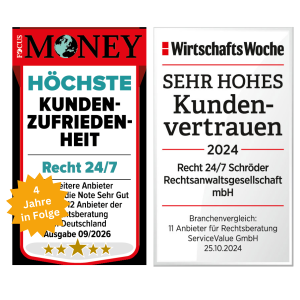
Recht 24/7 was the only online law firm to receive the Focus Money “Highest Customer Satisfaction” seal for the fourth consecutive year Recht 24/7 2023, 2024, 2025, and 2026 . The online law firm Recht 24/7 founded in 2003 with the slogan “Law can be simple” and has since helped more than 100,000 satisfied clients with all legal matters. This is also evidenced by the “Very High Customer Trust” award from WirtschaftsWoche in October 2024.
In the areas of trademark applications and start-ups, the firm filed the most applications in Germany in 2022 and 2021:
https://dev-recht24-7.de/dpma-markenanmeldung-mit-deutschlands-nummer-eins/