
Lawyer for tradesman services - what to do in the event of a dispute with tradesmen?


New windows, a fresh coat of paint for the walls or a luxurious bathroom renovation: you usually need a tradesman for work like this. However, tradesmen do not always complete jobs to the satisfaction of their customers. If defects occur, the frustration is great: Does the tradesman have to make improvements? Can I reduce the invoice or can I simply hire another tradesman? This article summarizes the legal regulations and when it is necessary to consult a lawyer.
The basis: The contract for work and services
If you are planning to hire a tradesman, you should first have a cost estimate drawn up. This shows what work is to be carried out and how much it will cost. If you then place a corresponding order and this is accepted by a tradesman, a contract for work and services is concluded. Under this contract, the contractor - i.e. the tradesperson - undertakes to carry out the work in accordance with the contract. You, on the other hand, are obliged to pay the invoice, provided that all the work has been completed correctly. For particularly extensive and expensive projects, it is advisable to have the contract checked by a lawyer before signing it. In this way, you can ensure that the work you require is precisely defined and that the contract does not contain any clauses that are disadvantageous to you. A comprehensive contract review is offered by our contract review - at a fair fixed price, including all follow-up questions.nullAlso interesting in this context: What distinguishes a construction contract from a property development contract?
Conclude a contract according to VOB or BGB?
As a private builder, you conclude a contract for work and services with a craftsman's business either in accordance with the German Civil Code (BGB) or the German Construction Contract Procedures (VOB). The difference lies in the respective length of the warranty period. According to the VOB, warranty rights expire four years after acceptance, while according to the BGB the period only expires after 5 years.
Warranty according to BGB
- Application: Valid for private construction contracts, unless otherwise agreed
- Advantages: Longer limitation period, effective legal protection
- Disadvantages: Limitation period continues to run while defects are being remedied
Warranty according to VOB
- Application: Optional for private clients, mandatory for public clients
- Advantages: Limitation period is 4 years, extension of the limitation period possible
- Disadvantages: If defects only become apparent after the deadline has expired, they do not have to be repaired by the contractor
The invoice is preceded by acceptance
Once all the work has been completed, an acceptance inspection is carried out. As the client, you check whether everything has been carried out in accordance with the contract. Important: According to § 640 BGB, you are obliged to accept the work. It states: "The customer is obliged to accept the work produced in accordance with the contract, unless acceptance is excluded due to the nature of the work."nullIf you do not fulfill your obligation to accept the work, the craftsman can set you a deadline. If this deadline expires without you expressly refusing acceptance and stating a defect, acceptance is deemed to have taken place. This process is referred to as "fictitious acceptance". The burden of proof is then reversed. This means that you as the client must prove that a defect actually exists. For this reason, defects should always be reported before acceptance in order to avoid disputes later on.
Warranty provides for the right to subsequent performance
If you discover defects before, during or after acceptance, you must report them to the tradesperson immediately and request that they rectify the defects within a specified period. According to § 439 BGB, the craftsman is obliged to rectify defects as part of the so-called rectification or subsequent performance. This is the only way he can fulfill the contract and complete the agreed work in accordance with the contract. Subsequent performance can be carried out in two different ways. Either the tradesman produces the work from scratch or he rectifies the existing defects in the existing work. The type of supplementary performance chosen is at the discretion of the contractor. The costs for supplementary performance are borne by the tradesman. This includes in particular
- Transportation and travel costs
- Labor costs
- Material costs
Any costs required for installation or removal must also be borne by the tradesman.
What can I deduct from the invoice in the event of defects?
If you notice defects after acceptance, you do not have to pay the full invoice amount. This is because: According to Section 641 (3) BGB, you can refuse to pay a reasonable part of the remuneration after the invoice is due (i.e. after actual or fictitious acceptance) - until the defect has been rectified. The amount that is considered "reasonable" as a retention in the case of defects is decided on a case-by-case basis. As a rule, twice the costs required to rectify the defect are deemed reasonable.
The 5 most common reasons for disputes
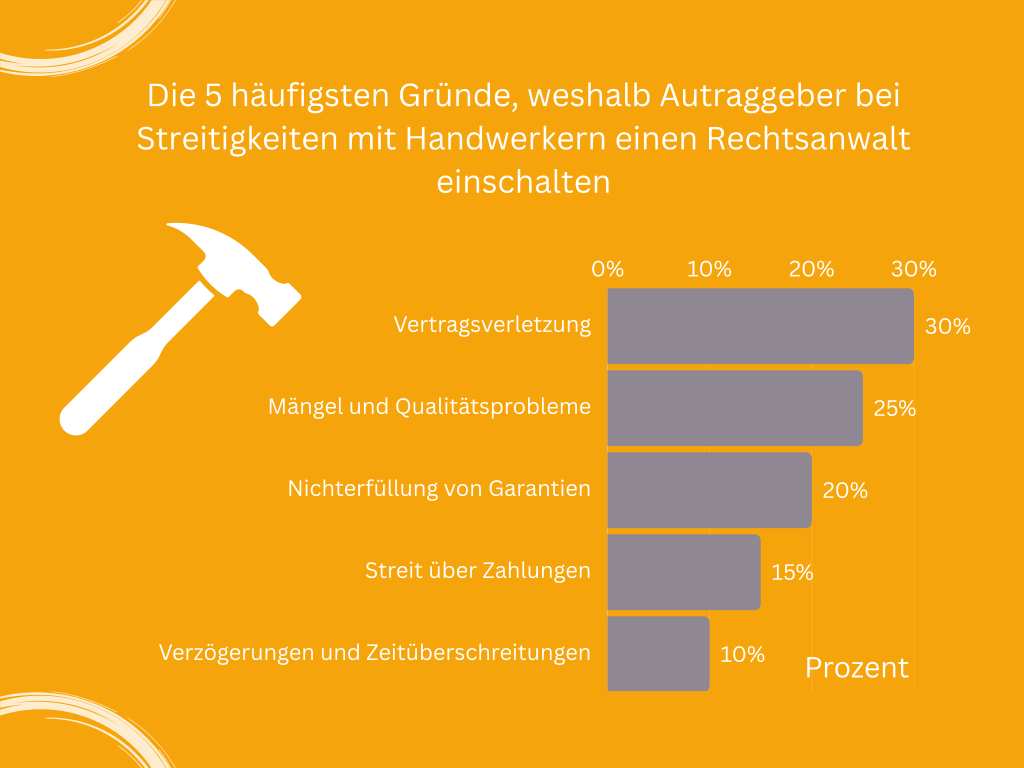 nullThere are several reasons why clients call in a lawyer when they have disputes with tradesmen. Here is a list of the 5 most common reasons, prioritized by frequency:
- Breach of contract: If the tradesman does not carry out the work specified in the contract as agreed or does not adhere to the time frame.
- Defects and quality problems: If the work carried out has defects or does not meet the agreed quality standards.
- Non-compliance with guarantees: If the tradesman does not comply with guarantees or warranties and the customer has problems with the work carried out.
- Disputes over payments: Disagreements regarding agreed prices, changes in the course of work or unpaid invoices can lead to legal disputes.
- Delays and time overruns: If the tradesman significantly exceeds the timeframe for completion of the work or causes unreasonable delays.
Is it possible to have defects rectified by another tradesman?
Tradesmen not only have the obligation, but also the right to supplementary performance. This means that you cannot simply commission a second tradesman to rectify any defects. Self-remedy - i.e. hiring a second tradesman - is only possible under certain conditions. For example, if the tradesman has allowed the deadline for supplementary performance to pass without rectifying the defects. Even if the defects persist - despite suitable supplementary performance measures - or the tradesman seriously and definitively refuses supplementary performance, you can call in a second tradesman.nullThe costs for the rectification of defects by a second tradesman are generally borne by the original contractual partner - i.e. the tradesman who is responsible for the defects. If you already know in advance what expenses are to be expected for the rectification of defects, you can request a corresponding advance payment from the tradesman.
Trouble with the tradesman: what to do
If there are any discrepancies regarding defects, the work carried out or the craftsman's invoice, your contractual partner is your first point of contact. Present your concerns objectively and ask for a statement from the tradesman. If this communication does not lead to a solution, you should seek external help. Some chambers of crafts have an arbitration board. This offers advice and helps you to reach an out-of-court settlement with the tradesperson. If this measure also fails, you should contact a lawyer to enforce your claims in court.
The most important facts in brief
- A cost estimate must be obtained before the order is placed
- The nature and scope of the work and the amount of remuneration should be set out in writing in a contract
- Clients are legally obliged to carry out an acceptance procedure
- In the event of defects, there is a right to subsequent performance within the scope of the warranty
- The commissioning of a second tradesman to rectify defects is only permitted under certain conditions
- An appropriate portion of the invoice may be withheld in the event of defects
- Advice centers of the chambers of crafts offer the possibility of an out-of-court settlement
Do you have questions about an existing work contract or are you already in trouble with a tradesperson? We can help you!
As part of our legal advice service, you will receive complete and comprehensive legal advice from a specialized lawyer - within 24 hours.
On request, our lawyers will represent you in court throughout Germany and take care of the written correspondence with your contractual partner.
Processing within 24 hours
Recht 24/7 was the only online law firm to receive the Focus Money “Highest Customer Satisfaction” seal for the fourth consecutive year Recht 24/7 2023, 2024, 2025, and 2026 . The online law firm Recht 24/7 founded in 2003 with the slogan “Law can be simple” and has since helped more than 100,000 satisfied clients with all legal matters. This is also evidenced by the “Very High Customer Trust” award from WirtschaftsWoche in October 2024.null
In the areas of trademark applications and start-ups, the firm filed the most applications in Germany in 2022 and 2021:
https://dev-recht24-7.de/dpma-markenanmeldung-mit-deutschlands-nummer-eins/