Save taxes with a holding company


Running a holding company? What sounds like an international corporation can be interesting for founders, start-ups and small companies - especially from a tax perspective. Read here to find out how to set up a holding company and what tax advantages it offers you.
Holding: What is that?
The term "holding company" refers to a corporate structure whose business purpose is to bundle investments in several companies and enterprises (the so-called "subsidiaries"). As the parent company, the holding company holds between 10% and 100% of the shares in the individual subsidiaries and derives its profits from them. The subsidiaries themselves act autonomously, i.e. for themselves in terms of company law and organization.
Who can set up a holding company?
A holding company can be founded by one or more persons. As a prerequisite for company formation , the managing directors must fulfill the requirements for a GmbH management. This means that
- You must have full legal capacity and be of legal age.
- You have not been convicted of a property crime.
- You must not be banned from a profession or trade.
The company formation of a holding company requires at least two legally independent companies that already exist or are newly founded. The legal form of the parent or subsidiary companies is not specified by law, but they must be corporations. For example, it is possible to set up a GmbH that acts as the parent company for an Unternehmergesellschaft (UG for short). Alternatively, start-ups with a small amount of share capital can set up two UGs, one of which acts as a subsidiary for the other.
How you go about setting up a GmbH or a UG is discussed in detail here.
Save taxes: How optimization by means of holding works
As soon as a company makes profits, these are taxed. Profits of a sole trader or a partnership are subject to income tax (top tax rate: 42%), profits of a GmbH are subject to corporation tax and trade tax, which results in a total tax burden of approx. 30%.
If your GmbH generates an annual profit of EUR 100,000, the following tax payments are due:
- Corporation tax (15 %): 15,000 euros
- Solidarity surcharge (+ 5.5 %): 825 euros
- Trade tax (16.45 %): 16,450 euros
This corresponds to a tax burden of EUR 32,275 (32.275%). This leaves EUR 67,725 as a profit distribution to the shareholder. This amount must also be taxed. The final withholding tax (25 %) in the above example is EUR 16,931.25, the solidarity surcharge due is 5.5 %, i.e. EUR 931.21. If the tax payments of the GmbH and the tax payments of the shareholder are added together, the total tax burden amounts to EUR 50,137.46, which corresponds to a tax rate of just over 50%.
Tax payments change considerably within a holding structure. The shareholders do not own the shares as natural persons, but via another corporation (subsidiary).
If a corporation now receives a profit distribution from another corporation, Section 8b (1) KStG in conjunction with Section 8b (5) KStG applies. § Section 8b (5) KStG applies. This states that 95% of the distributed profits do not have to be taxed. Only 15% (corporation tax), solidarity surcharge and trade tax are payable on 5%. For the above-mentioned profit distribution of EUR 67,725, this means that
- Profit distribution: 67,725 euros
- Taxable amount (5%): 3,386 euros
- Tax burden: 1092.91 Euro
The tax burden of EUR 1,092.91 corresponds to an effective tax rate of approx. 1.5 percent on the total amount and is therefore significantly lower than the tax burden on the distribution of profits to a private individual (approx. 50 percent).
Long-term opportunities for tax savings
Reinvestments
If only 1.5% tax is paid on dividends and capital gains of the holding company, the company has around 98.5% of the profit available for reinvestment. These are used by many companies to invest in other start-ups.
Conversion into a real estate GmbH
Following the conversion of a holding GmbH into a real estate GmbH, a 100% reduction in trade tax can be achieved as part of the so-called extended property reduction (Section 9 no. 1 sentence 2 GewStG). Only 15 percent corporation tax is payable on the rental income. In comparison, property tax on private assets - depending on marital status and income - is up to 45 percent.
Loans to shareholders
Liquid funds of a holding company can be granted as a loan to the shareholder. Although interest at arm's length must be charged on the loan, this is currently very low (approx. 1-2%) and can be claimed by the shareholder as income-related expenses for tax purposes.
Note: In the case of a loan to a shareholder, repayment by the shareholder must be secured (see Federal Fiscal Court ruling, case reference: IX R 36/15).
Pension payments
Each taxpayer can pay tax on up to EUR 54,000 per year at a tax rate of less than 42%. If the shareholder's taxable income falls when they retire, it is worth distributing part of the profit carryforwards each year. For example, if the profit distribution of the holding company is EUR 100,000 per year, around 60% of this is taxable in accordance with the partial income method (Section 32d (2) No. 3 EStG).
The annual payment of profit carryforwards and the associated use of a low tax rate results in a tax payment of only approx. 15,000 euros for an income of 60,000 euros instead of the normal flat-rate withholding tax of 25 percent (= 25,000 euros).
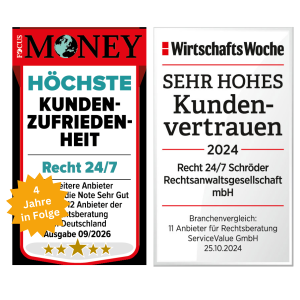
Recht 24/7 was the only online law firm to receive the Focus Money “Highest Customer Satisfaction” seal for the fourth consecutive year Recht 24/7 2023, 2024, 2025, and 2026 . The online law firm Recht 24/7 founded in 2003 with the slogan “Law can be simple” and has since helped more than 100,000 satisfied clients with all legal matters. This is also evidenced by the “Very High Customer Trust” award from WirtschaftsWoche in October 2024.
In the areas of trademark applications and start-ups, the firm filed the most applications in Germany in 2022 and 2021:
https://dev-recht24-7.de/dpma-markenanmeldung-mit-deutschlands-nummer-eins/