
Health insurance for founders


Health insurance is compulsory in Germany. Anyone switching from an employment relationship to self-employment must also think about the right health insurance.
If you want to turn your business idea into reality quickly, it's now quite easy. Many tedious things can now be done online, you can easily open accounts online and set up popular forms of company such as GmbH or UG online. One of the many decisions that have to be made when setting up a company is the issue of health insurance. Or more specifically: which makes more sense, statutory or private health insurance?
Health insurance: private or statutory?
If you were already privately insured before becoming self-employed, you will remain so when you become self-employed. Those with statutory insurance, on the other hand, have a choice: they can take out both private and voluntary statutory insurance, provided that certain deadlines are met:
- The statutory insurance obligation ends with the start of full-time self-employment.
- You must take out private or voluntary statutory insurance within a period of three months.
- You can only take out voluntary statutory insurance if you have been insured for at least 24 consecutive months in the five years prior to the expiry of compulsory insurance, or at least 12 consecutive months immediately prior to the expiry of compulsory insurance.
However, this question of health insurance only arises if you are self-employed as your main occupation. If you are self-employed on a part-time basis, you must already have private or statutory health insurance for your main occupation, which is still valid.
Private or statutory: advantages and disadvantages
Both options have advantages and disadvantages that need to be weighed up according to personal needs and requirements. In statutory health insurance:
- contributions depend on income and are therefore easy to calculate.
- the family can also be insured.
- however, co-payments may also be due for special services and medication.
- premiums can be higher than with private health insurance, especially for young people.
In private health insurance:
- The premiums are based on age and state of health and can therefore be cheaper for young people in particular than with statutory health insurance,
- services can be customized,
- However, contributions are set independently of income and can therefore lead to a high financial burden, especially in old age.
And very important: the decision should be well-considered, because a subsequent change from private to statutory health insurance is not possible for self-employed persons, or only if they take up an employment relationship.
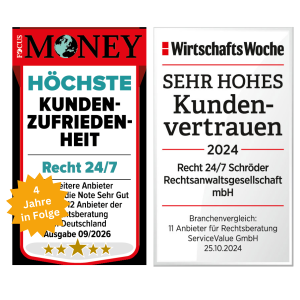
Recht 24/7 was the only online law firm to receive the Focus Money “Highest Customer Satisfaction” seal for the fourth consecutive year Recht 24/7 2023, 2024, 2025, and 2026 . The online law firm Recht 24/7 founded in 2003 with the slogan “Law can be simple” and has since helped more than 100,000 satisfied clients with all legal matters. This is also evidenced by the “Very High Customer Trust” award from WirtschaftsWoche in October 2024.
In the areas of trademark applications and start-ups, the firm filed the most applications in Germany in 2022 and 2021:
https://dev-recht24-7.de/dpma-markenanmeldung-mit-deutschlands-nummer-eins/