Illegal data transfer by mobile phone providers: An overview of the judgments

The forwarding of positive data by mobile phone providers to Schufa without the customer's consent has caused considerable uproar in recent years. Some judgments clarify the legal situation in this area.
What is positive data?
Positive data is information such as the number of current and old contracts with different providers or the date of invoice payment. Although they appear to be neutral, such data can allow negative conclusions to be drawn. A frequent change of mobile phone contract could be interpreted as an indication of provider hopping, which companies often view negatively.
Important rulings at a glance
- LG Munich I, judgment of April 25, 2023, Ref. 33 O 5976/22:** This judgment confirmed that Telefónica should have obtained voluntary consent to the transfer of data, which did not happen.
- LG Frankfurt a.M., judgment of May 26, 2023, Ref. 2-24 O 156/21:** Here, a clause of the energy supplier Eprimo was objected to because it enabled the transmission of positive data to credit agencies. The court also considered this to be a breach of the GDPR.
- Regional Court of Cologne, judgment of March 23, 2023, 33 O 376/22:** Despite rejection for procedural reasons in the first instance, the court took the same view as the Regional Court of Munich with regard to data disclosure. An appeal is expected.
- Mainz Regional Court, judgment of 12 November 2021 - 3 O 12/20:** This judgment awarded damages of 5,000 euros to a person affected after an unauthorized disclosure of data to Schufa.
- OLG Dresden, judgment of November 30, 2021 - 4 U 1158/21:** Here, too, a compensation sum of 5,000 euros was confirmed for unlawful data disclosure.
These rulings make it clear that the court system takes data protection and consumer rights seriously. According to Art. 82 of the General Data Protection Regulation (GDPR), data subjects are entitled to non-material damages if their data has been disclosed without consent.
Concluding thoughts
The judgments against mobile phone providers in relation to the disclosure of positive data send a clear signal. Data protection and individual rights must be upheld, and companies that disregard these principles must expect legal consequences. It remains to be seen how the mobile communications industry will adapt to this case law.
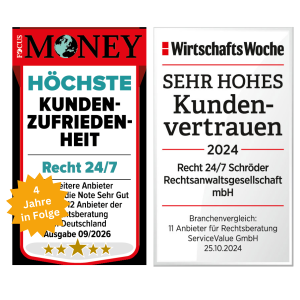
Recht 24/7 was the only online law firm to receive the Focus Money “Highest Customer Satisfaction” seal for the fourth consecutive year Recht 24/7 2023, 2024, 2025, and 2026 . The online law firm Recht 24/7 founded in 2003 with the slogan “Law can be simple” and has since helped more than 100,000 satisfied clients with all legal matters. This is also evidenced by the “Very High Customer Trust” award from WirtschaftsWoche in October 2024.
In the areas of trademark applications and start-ups, the firm filed the most applications in Germany in 2022 and 2021:
https://dev-recht24-7.de/dpma-markenanmeldung-mit-deutschlands-nummer-eins/