Cross-border commuters working from home: what you need to know in 2025


Many cross-border commuters no longer commute to work in Switzerland every day, but work partly from home in Germany. But what about the tax and social aspects when more than 24.9% of working time is spent working from home? In 2025, it will even be possible for cross-border commuters to spend almost half of their working time working from home without losing their status. But there are some important rules you should know!
Working from home in Germany: What does this mean for cross-border commuters?
Cross-border commuters are people who live in Germany but work in Switzerland. The status of a cross-border commuter is largely determined by the number of days on which the person travels to their workplace in Switzerland. Until now, cross-border commuters were only allowed to spend a certain proportion of their working time in their home office without losing their status. However, since July 2023, there have been new regulations that allow up to 49.9 percent of working hours to be spent working from home.
This means that cross-border commuters who regularly travel to Switzerland at least one day a week or five days a month can still be considered cross-border commuters, even if they do most of their work from home. This is a real relief for many who want to avoid the daily commuting stress.
The dark side: What happens if the upper limit is exceeded?
However, what happens if cross-border commuters exceed their home office days? If more than 49.9 percent of working time is spent in Germany, the employee loses their cross-border commuter status. This has significant consequences: Social security contributions must then be paid in Germany, which can lead to higher costs for the employee. The favorable Swiss health insurance is also no longer available and the employee must take out insurance in Germany - often at higher premiums.
In addition, the company employing the cross-border commuter could be confronted with tax and bureaucratic problems. This is because if too much work is done in the home office, it could be considered a branch in Germany. In this case, the company would have to fulfill tax obligations in Germany, which would result in additional costs and administrative work.
The role of the A1 certificate: An important step for cross-border commuters
Cross-border commuters who spend between 25 and 49.9 percent of their working hours working from home must ensure that their Swiss employer applies for an "A1 certificate" from the AHV compensation office. This certificate confirms that the employee remains covered by Swiss social insurance, even if they work part-time in Germany. Without this certificate, there could be considerable problems with social insurance and taxation.
A balancing act between flexibility and bureaucracy
The new regulation offers many cross-border commuters more flexibility, especially those who want to organize their working hours flexibly. However, there are also many pitfalls that should not be underestimated. Cross-border commuters who work too much from home could not only find themselves in a difficult situation in terms of tax and social security law, but could also inadvertently become a bureaucratic challenge for their company.
Flexibility yes, but beware of the pitfalls!
It is understandable that many cross-border commuters want more flexibility - especially after the experience of the pandemic. However, we warn of the consequences of being too lax with the new regulations. A small mistake when exceeding the home office limits could lead to unexpected costs and problems that many do not have on their radar. The question remains: How much home office is really still in the interests of a "marginal worker"? The line is thin - and anyone who crosses it could quickly end up on the wrong side of the bureaucracy.
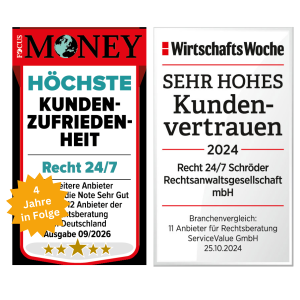
Recht 24/7 was the only online law firm to receive the Focus Money “Highest Customer Satisfaction” seal for the fourth consecutive year Recht 24/7 2023, 2024, 2025, and 2026 . The online law firm Recht 24/7 founded in 2003 with the slogan “Law can be simple” and has since helped more than 100,000 satisfied clients with all legal matters. This is also evidenced by the “Very High Customer Trust” award from WirtschaftsWoche in October 2024.
In the areas of trademark applications and start-ups, the firm filed the most applications in Germany in 2022 and 2021:
https://dev-recht24-7.de/dpma-markenanmeldung-mit-deutschlands-nummer-eins/