Profit distribution and taxation of a GmbH - avoiding pitfalls


The managing director's salary of the shareholders of a GmbH is determined by the shareholders' meeting. In a company where the managing director is the sole shareholder, he sets his own salary. This constellation often makes the tax office prick up its ears. As there is no control, inappropriately high managing director salaries could be possible. This would mean that the tax authorities could miss out on tax revenue if the profit reported is too low. From the GmbH's point of view, it is therefore important to avoid certain pitfalls in this context.
What components should the salary of a GmbH managing director include?
The employment contract that the GmbH has concluded with the managing director is decisive for the auditors from the tax office. This contract should contain the following remuneration components:
- Monthly fixed salary
- Vacation pay
- Christmas bonus
- Bonuses/ management bonuses
- Pension commitment
- Company car
- Remuneration in kind (in connection with the company)
The tax office auditors like to use a comparison here. In the internal comparison, the salary of the GmbH shareholder is compared with the salary of other external managing directors within the company. The external comparison is made with remuneration structures within the industry.
Interest on capital and the principle of half-sharing - how to avoid unpleasant questions from the tax authorities
A conscientious company manager follows these two principles when determining the remuneration of the managing director:
Return on capital:
As a prudent businessman, you pay attention to an appropriate return on equity. Here, the profit for a financial year, after payment of the managing directors' salaries, should still account for ten percent of equity.
Half-share principle:
Your GmbH is very successful and generates a high annual profit. In this case, the sum of all salaries of the managing directors should not be greater than the profit remaining in the GmbH. However, this rule of thumb only applies up to a reasonable level. If the GmbH's annual net profit is exorbitantly high, the right level should also be maintained here.
What is a hidden profit distribution in a GmbH? - A small calculation example
The tax authorities consider a hidden profit distribution to be a tax avoidance strategy on the part of the managing sole shareholder of the GmbH. This means either too high remuneration or too low performance calculations as a benefit for the managing director.
This is what the calculation looks like if the GmbH has an annual surplus of EUR 100.00:
- 15.0 % Corporation tax: 15.00 Euro
- 5.5 % solidarity surcharge: EUR 0.82 (levied on the corporate income tax rate)
- 30.0 % trade tax: 30.00 euros (measured figure plus individual assessment rate of the municipality)
- Profit after taxes: 54.18 euros
269.00 EURO - including advice on the start-up process
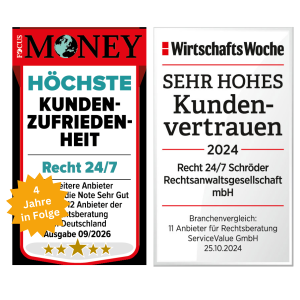
Recht 24/7 was the only online law firm to receive the Focus Money “Highest Customer Satisfaction” seal for the fourth consecutive year Recht 24/7 2023, 2024, 2025, and 2026 . The online law firm Recht 24/7 founded in 2003 with the slogan “Law can be simple” and has since helped more than 100,000 satisfied clients with all legal matters. This is also evidenced by the “Very High Customer Trust” award from WirtschaftsWoche in October 2024.
In the areas of trademark applications and start-ups, the firm filed the most applications in Germany in 2022 and 2021:
https://dev-recht24-7.de/dpma-markenanmeldung-mit-deutschlands-nummer-eins/