Germany in start-up fever - the UG is on the rise


Germany is in start-up fever: this impression could indeed arise if you look at the current figures from 2012. Over 618,000 start-ups were recorded last year, many of which are likely to be successful on the market in the long term. The reasons that prompted founders to embark on the path to self-employment are also rather insignificant.
Anyone who fights for their own existence with enthusiasm and passion and avoids the most important mistakes right from the start has already overcome the first major obstacles on the way to their own existence. So what are the latest insights that founders should bear in mind? And how can a young entrepreneur benefit from the experience of others? A look at the figures for 2012 shows the way.
Berlin and Hamburg as top locations
Even the search for a suitable location can cause a start-up company to fail. In 2012, around seven percent of start-ups were spread across three major cities: Berlin, Hamburg and Bremen accounted for the largest share of start-ups. Bremen surprises with a share of 2.19 percent, Hamburg shines with 2.3 percent, and the German capital accounted for a full 2.55 percent of the total number of start-ups in 2012. Rhineland-Palatinate and Schleswig-Holstein follow in next place, with no other major cities in the top ten. This is surprising, as Bavaria and Baden-Württemberg are traditionally regarded as financially strong federal states with very good prospects for business start-ups. So anyone thinking about setting up their own small company should perhaps opt for a location in the north of the country. It is not surprising that Berlin holds the top position, because anyone who observes the continuing positive mood in the federal capital quickly learns that the path from dishwasher to millionaire still seems possible here. The next step is to put the financing of the project on a solid footing. Here, too, Berlin is in first place.
Berlin leads the way in IT financing
A good 240 million euros were spent as venture capital for start-ups in the IT sector in 2012. An impressive 59% of this went to companies in the German capital. Baden-Württemberg took second place with a share of 11%, followed by Bavaria in third place with 8%. For founders, this is yet another indication of how sought-after Berlin really is compared to other German cities. The fact that venture capital financing is apparently well received by IT projects is only a side note. However, the combination of Berlin as a business location and the IT sector apparently provides a pioneering starting point that makes it much easier for young company founders to successfully launch their own business.
This is how important the type of company is
A young business founder must also deal with the question of the company form. The main focus here is on the capital that needs to be invested in the company. The liability of the company must also be considered. The entrepreneurial company (UG), also known as a mini-GmbH, is becoming increasingly popular. With a share of over 76,000, it accounted for by far the largest proportion of start-ups in 2012. In addition, it has enjoyed ever-increasing demand since 2009, as it limits liability and requires no start-up capital. With these groundbreaking tips, the number of start-ups is likely to remain at a high level in 2013.

219,00 EURO - processing in 24h
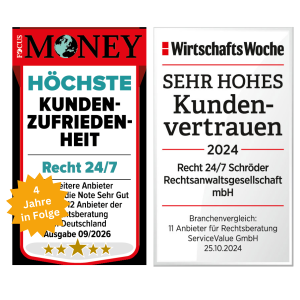
Recht 24/7 was the only online law firm to receive the Focus Money “Highest Customer Satisfaction” seal for the fourth consecutive year Recht 24/7 2023, 2024, 2025, and 2026 . The online law firm Recht 24/7 founded in 2003 with the slogan “Law can be simple” and has since helped more than 100,000 satisfied clients with all legal matters. This is also evidenced by the “Very High Customer Trust” award from WirtschaftsWoche in October 2024.
In the areas of trademark applications and start-ups, the firm filed the most applications in Germany in 2022 and 2021:
https://dev-recht24-7.de/dpma-markenanmeldung-mit-deutschlands-nummer-eins/