Generation Z wants a work-life balance - but in the USA the trend is towards constant stress


4-day week in Europe, 72-hour marathon in the USA?
While the four-day week is the subject of heated debate in Germany and many other European countries, the opposite is happening in the USA: some start-ups - particularly in the field of artificial intelligence (AI) - are introducing extreme working time models in which 70 or even more hours per week are quite normal. From 9 a.m. to 9 p.m. - six days a week. This is called the "996 model" and originally comes from China.
The start-up Rilla from San Francisco has adopted this practice. According to the job advertisement, you don't even need to apply if you're not prepared to work 70 hours a week.
Other well-known tech figures such as Elon Musk and Google co-founder Sergey Brin are also fans of the extremely long working week. In an infamous email to all Twitter employees in 2022, Musk called for "extreme hardcore" assignments - with long working hours and high intensity. The 996 model is now officially illegal in China because it violates local labor law. It is ironic that the USA, of all countries, is now adopting this controversial working style.
Burnout risk on the rise - and Germany prefers to watch the clock
But what is the real benefit? According to a US survey by Care.com, around 70% of respondents currently feel overloaded by their work - the highest level for a long time. The result is exhaustion, which can go so far that people only do the bare minimum to avoid losing their job.
In contrast, a large-scale trial in the UK shows that less is often more. 60 companies tested the four-day week, and the results were clear: employees were more productive, sick less often and felt less stressed.
The topic is also present in Germany - especially among Generation Z, i.e. those born between 1995 and 2010. Many of them have little use for the classic "9 to 5" job. Instead, they want more flexibility, less stress and a real balance between life and work.
Economy warns: Please work harder
However, not everyone finds this desire for more free time appealing. On the contrary, Ifo President Clemens Fuest is calling for Germans to work more. Especially in view of the declining number of skilled workers and the growing pressure from technologies such as artificial intelligence.
Competition is indeed increasing - internationally too. And while people in Europe are thinking about how to make work more pleasant, the pressure is increasing in the USA: young tech talent in particular is having a hard time, as the latest figures from the US Federal Reserve show. Among them, the unemployment rate has recently risen faster than the average.
Joke or reality?
Working 72 hours a week? Sounds like a bad joke - but it is apparently a reality for some tech companies. Sure, success doesn't come by itself. But anyone who believes that burnout is collateral damage of productivity has learned nothing from the last few years. What we need is not a return to a culture of constant stress, but a new understanding of performance. People who live by the clock are not lazy - they are smart enough to set limits.
Source: Frankfurter Rundschau
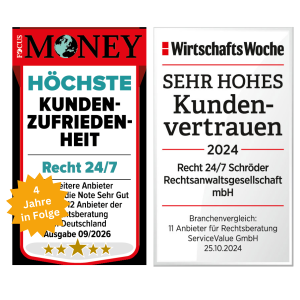
Recht 24/7 was the only online law firm to receive the Focus Money “Highest Customer Satisfaction” seal for the fourth consecutive year Recht 24/7 2023, 2024, 2025, and 2026 . The online law firm Recht 24/7 founded in 2003 with the slogan “Law can be simple” and has since helped more than 100,000 satisfied clients with all legal matters. This is also evidenced by the “Very High Customer Trust” award from WirtschaftsWoche in October 2024.
In the areas of trademark applications and start-ups, the firm filed the most applications in Germany in 2022 and 2021:
https://dev-recht24-7.de/dpma-markenanmeldung-mit-deutschlands-nummer-eins/
Want to find out more about work-life balance and constant stress? Get a consultation with our experts now and make your future stress-free!