Are five months in prison too much for climate activists? "Nothing else impresses the defendants"
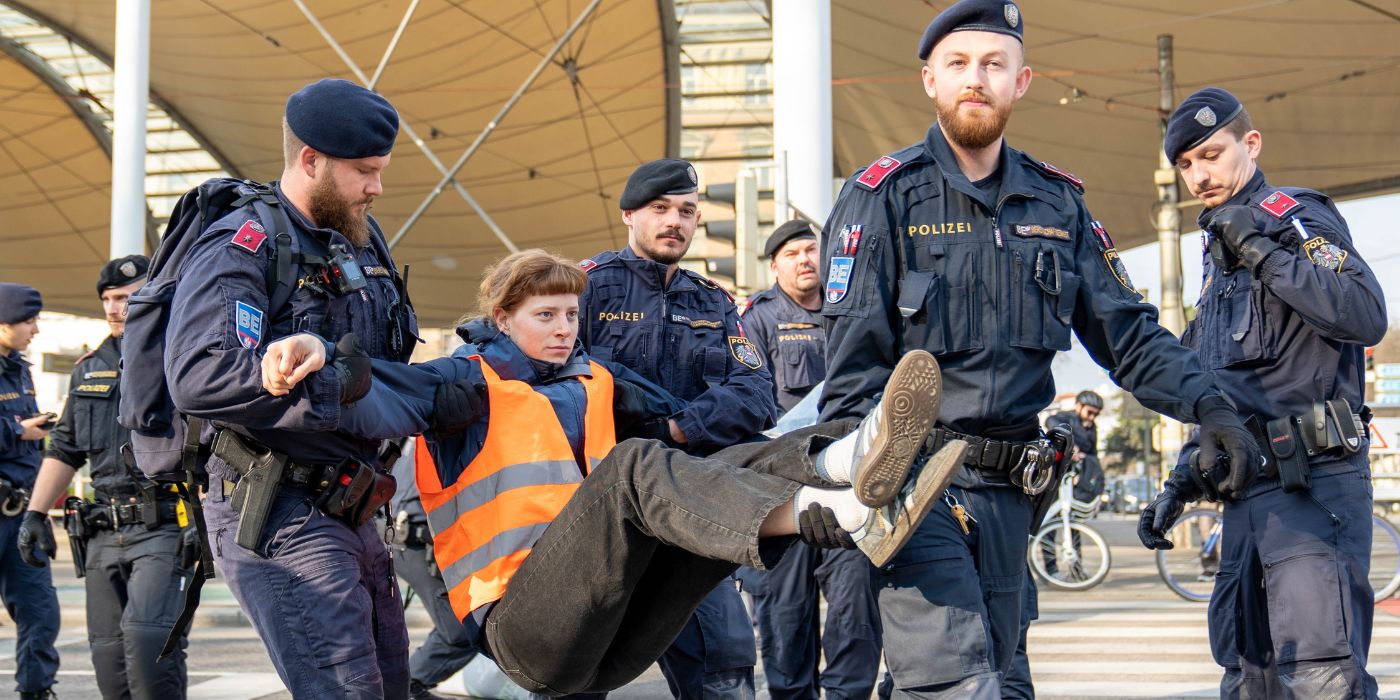

Several climate activists were recently given harsh sentences in Heilbronn. Judge Julia Schmitt sentenced two men and one woman to prison terms of five, four and three months without probation for coercion - because they had blocked a road for several hours. The sentence was sometimes seen as too harsh, but was also applauded. The tough judge? The Heilbronn district court takes a different view. Nothing else would impress the defendants, the judge stated in her reasons for the verdict.
Criticism of harsh penalties
However, experts are critical of the decision. Katrin Höffler, Professor of Criminal Law, Criminology and Sociology of Law at the University of Leipzig, for example, denies that harsher penalties have a positive effect: "A higher sentence is not a deterrent, on the contrary, accepting serious negative consequences is precisely part of the protest. Negative labeling is more likely to lead to greater division," she told the Tagesspiegel. Tobias Singelnstein, Professor of Criminology and Criminal Law at Goethe University in Frankfurt am Main, is of a similar opinion.
Support for the local court
Michael Reißer, the press spokesman for Heilbronn district court, disagrees and points to an example from practice: "Ms. Schmitt has suspended one of the suspended sentences. The defendant has affirmed that he now wants to concentrate on his education and no longer wants to have anything to do with climate activism. We assume here at the court that the harsh sentence previously imposed has fallen on fertile ground".
The CDU/CSU also supports the district court's decision. Günter Krings, legal policy spokesman for the CDU/CSU parliamentary group in the Bundestag, criticized the overly lenient penalties imposed by the judiciary. "We need to deter more so-called climate activists from committing crimes across Germany by increasing the statutory penalties," Krings told the Tagesspiegel newspaper.
Michael Reißer emphasizes that the most recent ruling by the Heilbronn district court makes it clear that the rule of law is at least capable of acting in the event of a repeat offence: "A prison sentence can only be suspended on probation if there is a positive social and criminal prognosis"
The ruling by Heilbronn District Court is another example of the controversy surrounding the treatment of climate activists. It shows that the decision on the appropriate punishment for protest actions is not only a matter of criminal law, but also of political considerations. The question of whether penalties act as a deterrent or further fuel protests remains open. What is certain, however, is that even a good cause does not justify criminal means. Protests must take place within the framework of the rule of law.
It remains to be seen whether the CDU/CSU will be successful with its motion in the Bundestag. One thing is certain: the controversy surrounding the climate protest will continue.
Recht 24/7 was the only online law firm to receive the Focus Money “Highest Customer Satisfaction” seal for the fourth consecutive year Recht 24/7 2023, 2024, 2025, and 2026 . The online law firm Recht 24/7 founded in 2003 with the slogan “Law can be simple” and has since helped more than 100,000 satisfied clients with all legal matters. This is also evidenced by the “Very High Customer Trust” award from WirtschaftsWoche in October 2024.

In the areas of trademark applications and start-ups, the firm filed the most applications in Germany in 2022 and 2021:
https://dev-recht24-7.de/dpma-markenanmeldung-mit-deutschlands-nummer-eins/