Florence takes action against key boxes - An attack on landlords' freedom?


The battle for Florence's key boxes: what's really behind it?
Florence, the city of art and culture, has taken a radical step: the city council is now banning the so-called key boxes that are used in vacation apartments for self-check-in. What sounds like a harmless measure could, however, have a profound impact on tourism and the housing market - not only in Florence, but also in many other European cities.
Why Florence is striking now
With the ban, the Italian capital of Tuscany is sending a strong signal against mass tourism, which is changing the cityscape and the lives of its inhabitants. The key boxes, which allow guests to hand over their keys quickly and easily, have long since become a symbol of short-term rentals. But many Florentines see them as a threat to their quality of life. Historic apartments are increasingly being turned into Airbnb rooms, and city dwellers are having to put up with inflated rents and a constant stream of tourists. The engineer Leonardo Lani, who is the only permanent resident in a building full of vacation apartments, speaks of a "dying type of person" - a drastic reference to the changed circumstances.
A tough step, but a necessary one?
The ban on key boxes, which is effective immediately in Florence, is intended to slow down the rapid growth of mass tourism and at the same time counteract anonymous rentals. With this regulation, the city council and citizens want to combat the undesirable side effects of short-term rentals - from rising rents to noise pollution and wear and tear on buildings. However, critics of the measure, including property owners' associations, see it as state intervention that restricts the freedom of landlords and further tightens the housing market.
Does the ban mean the end of flexibility?
Vacation rentals via platforms such as Airbnb are a lucrative source of income for many owners. A simple system, such as the key box, made this type of rental particularly flexible and unbureaucratic. The new regulation affects precisely those who rely on this flexibility. While Florence is making efforts to relieve the city of floods of tourists, it will be interesting to see whether other cities follow suit and whether these measures actually offer a solution to the overstretched heritage of Europe's cultural assets.
Is overregulation really the solution?
The question arises: who really decides how much tourism a city can tolerate? In Florence, a ban on key boxes may be the wrong approach. Instead of over-regulating, the focus could rather be on relieving the housing market and shaping tourism in a more sustainable way. However, at a time when cities are increasingly becoming tourist attractions and demand for short stays is growing, the trend towards regulation is unfortunately becoming ever stronger. Will this type of political intervention help to preserve cultural heritage in the long term - or will it ultimately unnecessarily restrict the freedom of landlords? A difficult balancing act that is sure to trigger many more discussions.
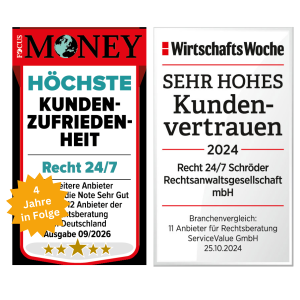
Recht 24/7 was the only online law firm to receive the Focus Money “Highest Customer Satisfaction” seal for the fourth consecutive year Recht 24/7 2023, 2024, 2025, and 2026 . The online law firm Recht 24/7 founded in 2003 with the slogan “Law can be simple” and has since helped more than 100,000 satisfied clients with all legal matters. This is also evidenced by the “Very High Customer Trust” award from WirtschaftsWoche in October 2024.
In the areas of trademark applications and start-ups, the firm filed the most applications in Germany in 2022 and 2021:
https://dev-recht24-7.de/dpma-markenanmeldung-mit-deutschlands-nummer-eins/