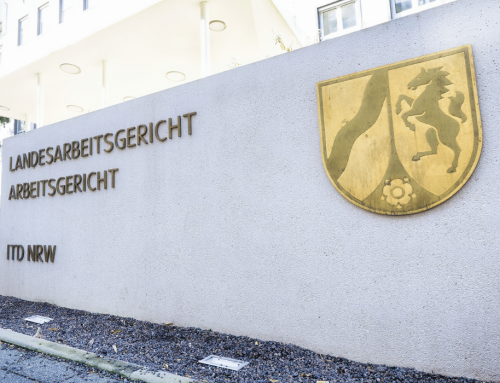
Federal Labor Court on video surveillance in the workplace: "Even inadmissible recordings can be used in court proceedings"


The Federal Labor Court (BAG) Federal Labor Court (BAG ) (judgment of 29.06.2023, ref. 2 AZR 296/22) has clarified in a recent ruling the question of whether inadmissible video surveillance at the workplace may be used as evidence in dismissal protection proceedings. The BAG's decision makes it clear that even recordings that violate data protection regulations can be used in court under certain circumstances. In this blog post, we take a closer look at the background and implications of this groundbreaking decision.
The case
In the case in question, an employer had equipped the factory premises with surveillance cameras and posted signs indicating the video surveillance. An employee was accused of leaving the premises before the start of the shift and still collecting wages for the shift. The employer relied on an anonymous tip-off and the existence of video recordings documenting the incident.
The prohibition on the use of evidence
The employee concerned then filed an action for unfair dismissal and argued that the video surveillance violated data protection law. In addition, the recordings had been stored for longer than stated. The employee invoked a company agreement which stated that the video recordings may not be used to evaluate personal data. Both the Labour Court and the Lower Saxony Regional Labour Court (LAG) agreed with the employee and recognized a ban on the use of evidence.
The decision of the BAG
The BAG, however, saw the situation differently and overturned the decision of the LAG. It emphasized that compliance with data protection law does not automatically result in a ban on the use of evidence. In particular, if there was intentional misconduct on the part of the employee and the video surveillance was announced by signs and was obvious, the recordings could be used as evidence in dismissal protection proceedings.
Weighing up conflicting interests
The BAG emphasized that in the event of termination without notice due to intentional misconduct, the employer's interest in clarifying the facts of the case outweighs the employee's data protection interests. An exception only exists if the open surveillance measure would constitute a serious violation of fundamental rights. However, this was not established in the present case.
Consequences and reactions
The decision of the Federal Labor Court confirms its previous line, according to which data protection does not automatically mean protection of the perpetrator and prohibitions on the use of evidence are only assumed in the event of serious violations of data protection regulations. Experts welcome the BAG's decision as a consistent continuation of this line.
Recht 24/7 was the only online law firm to receive the Focus Money “Highest Customer Satisfaction” seal for the fourth consecutive year Recht 24/7 2023, 2024, 2025, and 2026 . The online law firm Recht 24/7 founded in 2003 with the slogan “Law can be simple” and has since helped more than 100,000 satisfied clients with all legal matters. This is also evidenced by the “Very High Customer Trust” award from WirtschaftsWoche in October 2024.

In the areas of trademark applications and start-ups, the firm filed the most applications in Germany in 2022 and 2021:
https://dev-recht24-7.de/dpma-markenanmeldung-mit-deutschlands-nummer-eins/