
Founding a company: The founder's guide from Recht 24/7 accompanies you to your goal


Do everything right from the start: Finding a business idea, drawing up a business plan, choosing the right legal form. The Recht 24/7 start-up guide is an easy-to-understand step-by-step guide to successfully setting up a business.
Starting your own business is a complex topic. Only very few founders are already familiar with the subject when they start their own business. Reason enough for Recht 24/7 to pass on the necessary know-how to start-ups like you. We will provide you with a detailed roadmap so that you can get your company off the ground quickly, legally compliant and, above all, successfully.
The company formation a company takes place in 4 phases
Phase 1: Developing a business idea
What makes a good business idea? What requirements should founders have? How and where do you present your company?
Phase 2: Business plan & legal form
How do you make a business plan? What content must it contain? What legal forms are there? Which one is right for you?
Phase 3: Business account, authorizations and contracts
Why do you need a business account? Which contracts should you draw up? And what authorizations do you need to make sure your business is legally compliant?
Phase 4: Fine-tuning & looking ahead
Is it worth investing in a customer relationship management tool (CRM)? Do you need employees to take your business to the next level?
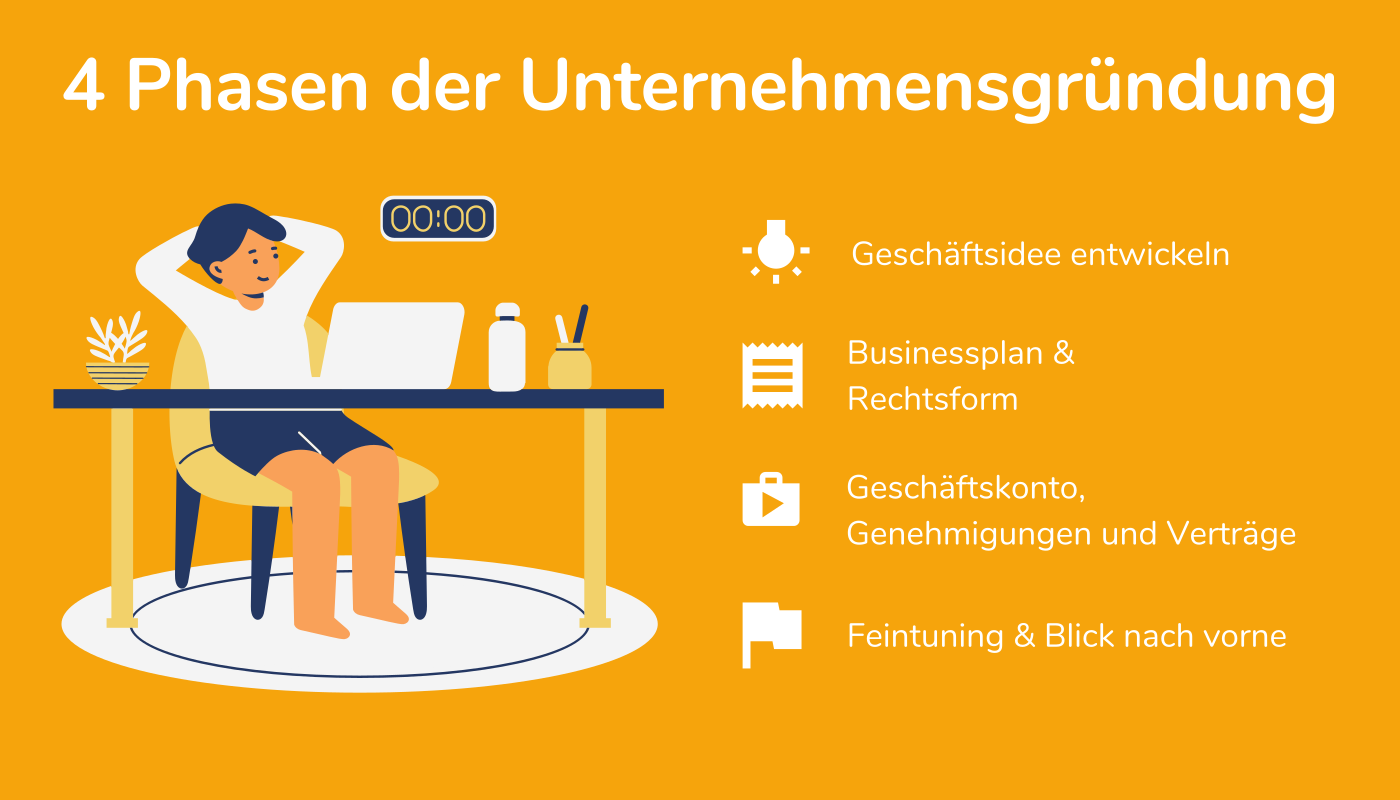
As you can see, there are many cogs that need to mesh together for a successful company foundation, which we present as an overall process in this Founder's Guide. If you are particularly interested in individual aspects, click on the topic to go directly to the relevant paragraph.
Phase 1: Developing a business idea
Founding a company: The idea is the basis
Once you have decided to set up your own company, you first need a brilliant business idea. This should not only work well on the market in the long term and provide you with a secure livelihood, it must also suit you as a person. So ask yourself:
- What do you enjoy?
- What are you particularly good at?
- Which industry can you imagine working in for many years?
- Does your product or service solve a problem that many people have?
- Are customers willing to pay for the solution to the problem?
- Can your business idea be sustainable?
Are you still missing the right business idea? Let our clients and their start-up stories inspire you. You can also find interesting business ideas and successful young companies at https://techcrunch.com/ and - for the fastest growing companies - at https://growjo.com/.
Check the requirements for setting up a business
What requirements should you fulfill in order to start your own company? We'll tell you!
Formal requirements: When can you start a company?
In Germany, any person of legal age can set up a company. Minors can also become shareholders in a GmbH or UG and set up a company - but only with the consent of their legal representatives and the guardianship court.
EU citizens also have the opportunity to become self-employed in Germany due to the freedom of establishment and trade. In terms of the requirements, they are on an equal footing with German citizens.
For non-EU citizens, on the other hand, separate legal provisions apply. They require either a residence permit that includes self-employment or a permanent settlement permit. The latter is usually granted if the applicant can demonstrate a secure livelihood, sufficient knowledge of the German language and a multi-year residence permit.
Professional requirements: What do I need to set up a company?
Depending on your business idea, specialist qualifications may be required to set up a company.
If you want to start your own business as a bricklayer, roofer or chimney sweep, for example, you will need a corresponding master craftsman's certificate - as in many other trades. In order to open a catering business, you need a catering license (known as a concession) in addition to the business registration. In addition, some professions are subject to a so-called permit requirement. You can find out what these are in § 29 ff. of the Trade, Commerce and Industry Regulation Act.
| Federal state | Further information |
| Baden-Württemberg | Service portal BW |
| Bavaria | Service portal Bavaria |
| Berlin | Official capital city portal |
| Brandenburg | EAPBbg |
| Bremen | Bremen Chamber of Commerce |
| Hamburg | Hamburg Chamber of Commerce |
| Hesse | Hesse service platform |
| Mecklenburg-Western Pomerania | Neubrandenburg Chamber of Industry and Commerce |
| Lower Saxony | Service portal Lower Saxony |
| North Rhine-Westphalia | Chamber of Industry and Commerce NRW |
| Rhineland-Palatinate | BUS Rhineland-Palatinate |
| Saarland | Ministry of Economic Affairs, Labor and Transport |
| Saxony | Saxon State Chancellery |
| Saxony-Anhalt | State Chancellery of Saxony-Anhalt |
| Schleswig-Holstein | IHK Schleswig-Holstein |
| Thuringia | Erfurt Chamber of Industry and Commerce |
Regardless of this, as a business founder you should have business management and commercial knowledge. This will help you to keep track of income, expenditure, sales and earnings and to keep your books correctly. Social and communication skills are also important. For example, when negotiating with banks or investors, or communicating with employees and business partners. And if you have a basic understanding of the law, you can usually resolve disagreements with customers on your own.
Personal requirements for your company
Do you meet the formal and professional requirements? Great! But your personal requirements are also important for the success of your company. After all, starting a business requires perseverance and the ability to motivate yourself every day, even in the face of setbacks.
Be prepared to invest a large part of your time in building your business. Setting up a company is not a nine-to-five job, but requires all your capacities. Your family - as well as your circle of friends - should support your business start-up.
By the way: Our article "From business idea to founder" tells you in detail what qualities characterize a successful entrepreneur.
Finding a location and business premises
The location and business premises of your company are an important aspect of your success. If you initially want to work from home, make sure that you have a quiet place to work, including a computer, internet access and telephone. Often, an internet-based business model does not need any problems at the beginning and it is perfectly possible to set up the company from home.
Perhaps your own four walls are too small for a home office or you are planning to set up a larger company with employees and customers on site. Then you start looking for a suitable location. The focus here is on your customers. So don't let personal factors - such as proximity to your home - guide your choice, but always keep your company in mind.
The most important factors are:
- Location, accessibility and transport links
- Catchment area for the target clientele
- Proximity to suppliers
- Proximity or distance to competitors
Use mobile office or virtual office as an alternative
Are you not dependent on business premises or production facilities? Then you can choose to work in a mobile office or use a virtual office. This allows you to rent a business address where you can be summoned, but where you do not work yourself. Instead, the provider's employees will take care of the services you require. These include, for example
- Answering and coordinating calls
- the acceptance of mail and parcel deliveries
- Customer support and advice by telephone
Some service providers also offer you the option of renting an office or conference room at short notice for client meetings. However, even this is not a mandatory requirement. A sign on your own letterbox is enough to get you started.
Find logo and company name
Finding a good logo and a distinctive company name is one of the most exciting tasks when setting up a business - but also one of the most important. After all, they appear everywhere and represent your business on business papers, in email signatures or on the doorbell sign.
A good company name is short, easy to remember and is aimed directly at your preferred target group. Ideally, it already suggests which service or product your company offers. Typical examples of such brand names are Volkswagen and Lieferando. If you offer lifestyle products or your company pursues a particularly innovative concept, it can also be a catchy fantasy name.

Similar requirements apply to the company logo. It should be distinctive and memorable as well as easy to understand. Ideally, your customers will already recognize the direction of your product or service offering from the company logo.
Important: Make sure in advance that the company name and logo are not already being used by another company or are legally protected. Our expert trademark lawyers can help you with this.
Object of the company
If you set up a GmbH, AG or UG or a partnership with an entry in the commercial register, you must formulate a business purpose for your company. This describes the area and type of activity of your company.
Ideally, the purpose of the company should be reflected in the company name - in other words, it should characterize the inner essence of your company or product. So-called speaking company names such as:
- Organic bakery Meier
- Car rental Schulze or
- Master painter Müller
are easy to remember and allow customers to recognize at first glance what your company offers.
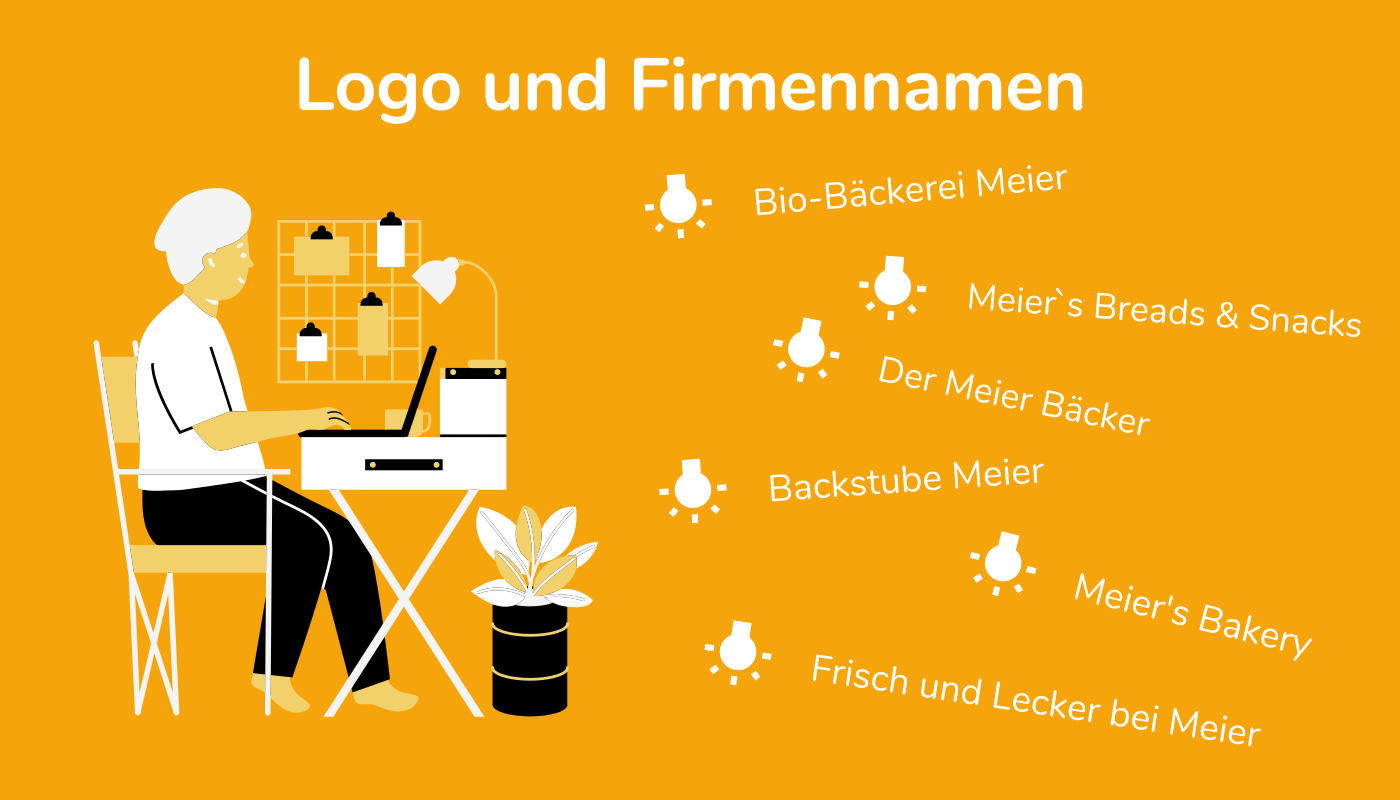
The object of the company must then be described as precisely and accurately as possible in the application to the commercial register. General formulations such as "trade in goods of all kinds" or "import and export" are regularly rejected as not registrable.
Phase 2: Business plan & legal form
Create a business plan
A business plan is a basic requirement for setting up a company. In a business plan, you describe your entrepreneurial project in detail. From the business idea and its implementation to the opportunities and risks of your company.
Roughly speaking, a business plan is structured as follows:
- Business idea, offer and target group
- Market and competition
- Goals
- Corporate strategy and marketing
- Legal form and taxes
- Founding team and organization of the company
- Finances
- SWOT analysis (an analysis of your company's strengths, weaknesses and risks)
- Summary
Creating a business plan has many advantages when setting up a company. On the one hand, it serves as a structure and orientation during the start-up phase, and on the other hand, the market situation and the required capital are precisely determined.
However, you are not only writing a business plan for yourself. Potential investors or business partners will also take a close look at your business plan before they agree to support you or work with you. For this reason, you should pay particular attention to the financial section. It indicates how much capital you need to set up the company, how turnover and profits will develop and what the biggest cost drivers will be in the first few months of operation. This is important to show potential investors the potential of your company.
Legal form and costs for founding a company
You have already come across the term "legal form" in the "Business plan" section. But what exactly does it mean? Put simply, the legal or corporate form is the legal framework of your company. It determines, for example, how liability is regulated, what taxes are incurred and how the individual shareholders of your company relate to each other. In Germany, you can choose between the following legal forms when founding a company:
Partnerships
- Sole proprietorship
- Registered merchant (short: e.K.)
- Company under civil law (GbR for short)
- Limited partnership (KG for short) or general partnership (OHG for short)
- GmbH & Co. KG
Corporations
- Limited liability company (GmbH for short)
- Entrepreneurial company (haftungsbeschränkt, short: UG)
Public limited company (AG for short)
Founding a sole proprietorship & costs
- Share capital: not required
- Foundation costs: approx. 100 Euro
You can set up a sole proprietorship in various ways.
- You register a small business with the trade office
- You are setting up a company that is larger than a small business. Then you must register with the commercial register in addition to registering your business.
- You inform the tax office about your activity as a freelancer and apply for a tax number.
The company formation a sole proprietorship is comparatively simple and inexpensive. You do not need any share capital, but in return you are liable with your private assets. Your tax burden depends on the type of sole proprietorship. Small entrepreneurs generally only pay income tax, while freelancers may also have to pay VAT.
By the way: If you later decide to change the legal form of your sole proprietorship, this is possible. You can find comprehensive information on this in our blog article "Changing your sole proprietorship to a GmbH".
Founding a GmbH & costs
- Shareholders' agreement and list: approx. 320 euros
- Registration in the commercial register: approx. 150 Euro
- Share capital for GmbH company formation: 25,000 euros
- additionally: notary fees, business registration
The GmbH is a form of corporation and is liable as a legal entity. This means that you are not liable with your private assets, but only with the company's assets (limited liability). Classification as a legal entity also has advantages when it comes to GmbH taxes. As a rule, a GmbH pays a maximum of 30 percent tax. This is made up of corporation tax, solidarity surcharge and trade tax.
However, setting up a GmbH and handling its bookkeeping involves a comparatively high level of bureaucracy.
Founding a UG (haftungsbeschränkt) & costs
- Share capital: 1 Euro
- Registration in the commercial register: approx. 150 Euro
- additionally: notary fees, business registration
In terms of liability and taxation, a UG (also known as a mini-GmbH) and a GmbH are very similar. The company formation of an entrepreneurial company (UG) is already possible with a share capital of 1 euro. In this article, we explain why a higher share capital is still recommended.
We have summarized the other advantages and disadvantages of a UG-companycompany formation for you here.
Important: Although the company formation of a UG is already possible with a share capital of EUR 1, the amount of the notary fees is calculated on the basis of the object value, which is set at a flat rate of EUR 30,000 regardless of the actual share capital.
Found a KG
- Share capital: no specifications
- Shareholder agreements: around 300 euros
- Registration in the commercial register: approx. 150 Euro
- additionally: notary fees, business registration
The legal form of a limited partnership (KG) is a special form of partnership. Some partners (limited partners) are only liable with their capital share, others (general partners) with their entire private assets. This means that at least two partners are required for the company formation of a KG - one limited partner and one general partner.
Shareholders in a KG pay income tax. In addition, the profit from the KG is divided among all shareholders and is subject to VAT.
GmbH/UG (limited liability) & Co. Found a KG
- Share capital: 25,000 (GmbH), 1 euro (UG)
- Shareholder agreements: around 500 euros
- Registration in the commercial register: approx. 150 euros per company
- additionally: notary fees (for both companies), business registration
Both GmbHs and UGs can be registered as GmbH & Co. KG or UG & Co. KG can be founded. The suffix "Co. KG" stands for "Compagnie Kommanditgesellschaft". This combines the liability advantages of a corporation with the tax advantages of a partnership.
With the company formation of a GmbH & Co. KG, the GmbH takes over the management. The limitation of liability of the GmbH in the amount of its share capital therefore also applies to the KG. The disadvantage: Although a GmbH & Co. KG can be founded online, two separate companies are founded and operated.
Financing the start-up
Setting up a company involves costs. For this reason, it is important that you consider the costs of setting up a company and the financing options at an early stage.
Founders often underestimate the capital required to start a company. It can take weeks, months or even years before your newly founded company is established on the market and generating profits.
First create a capital requirements plan. Include all costs incurred, in particular investments for:
- Operating resources (office equipment, electronic devices)
- Purchase or rent of business premises
- Company vehicles or machines
- Costs for services
- Cost of goods sold
- Costs for opening a business, business registration and notary
In addition, there are the costs for insurance, tax prepayments and any expenses for your company's website and advertising.
If you want to set up your company without capital, you can finance these costs externally. For example, with a bank loan or through crowdfunding.
Using subsidies to set up a company
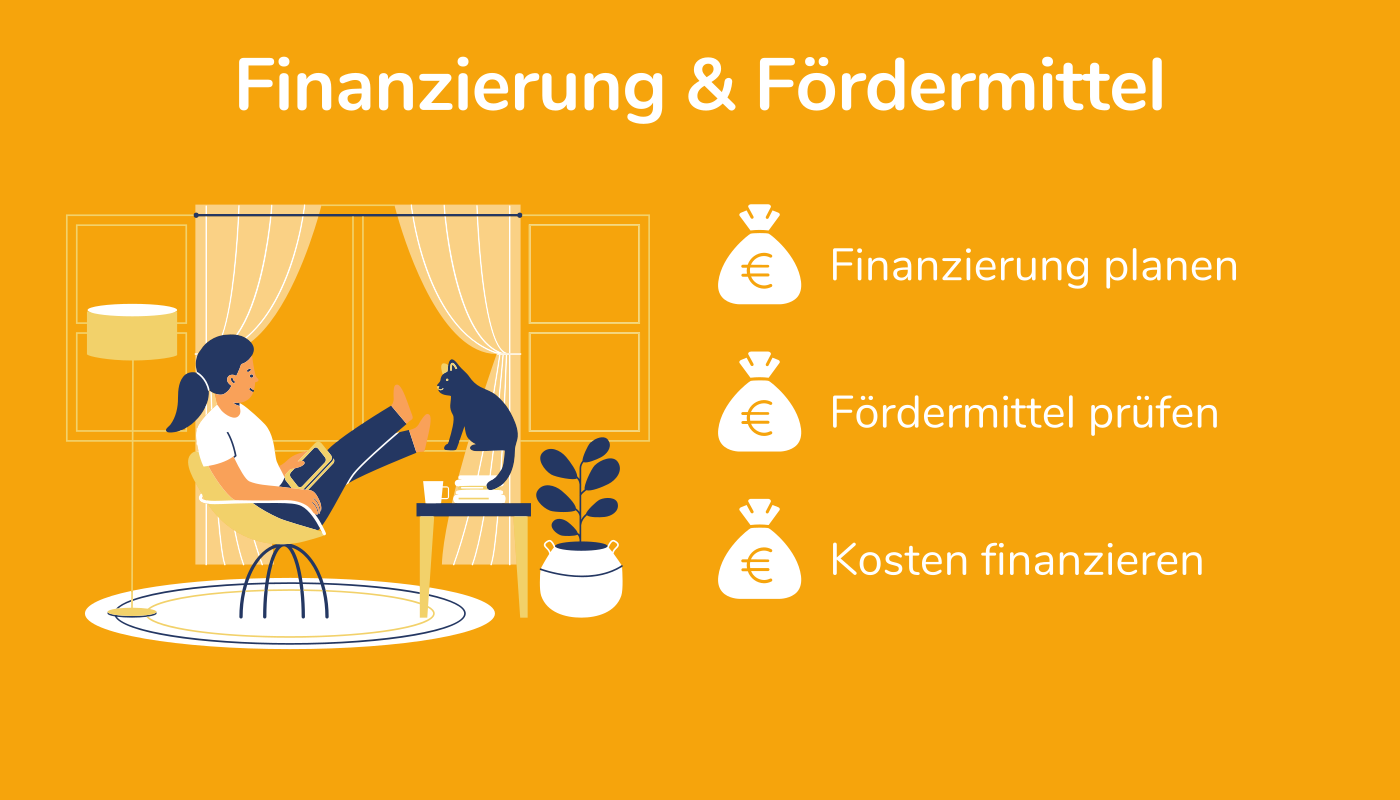
Some start-up costs can be covered with subsidies for setting up a business. For example with:
- KfW promotional loans
- the start-up subsidy and start-up allowance (recipients of ALG I or ALG II)
- Micromezzanine fund
On this website you will find funding for your self-employment clearly sorted by federal state.
Phase 3: Business account, authorizations and contracts
Once you have decided on a legal form and calculated the financing, the planning phase is complete. Now you register your company for business operations.
Opening a business account
A separate account for your self-employment? A good idea! Although you can theoretically use your private account for business transactions, there are two arguments against this. Firstly, many banks exclude the business use of a private account in their GTC , and secondly, private and business transactions can be precisely separated with a business account. This helps you with your tax return, as the account statements for your business account are considered tax-relevant documents.
Credit cards are often included with a business account. The type of card is important here. With debit or prepaid cards, amounts due are debited very promptly. An advantage for your cost control. However, these types of cards are often not accepted by hotels or car rental companies, which can be a problem when traveling on business.
You will need the following documents to open a business account:
- Proof of identity
- Registration with the trade office
- Extract from the commercial register
- Articles of association and list of all shareholders (only for limited liability companies)
Agree contracts
Contracts create legal certainty - especially if you want to set up your company together with business partners. A partnership agreement is essential to precisely define the tasks, rights and obligations of all parties involved. This contract not only regulates the basis for the company formation, but also ensures the subsequent smooth continuation of the company.
A partnership agreement regulates all important core elements of day-to-day business operations. These include, for example
- Regulations in the event of illness
- Internal relationship of the shareholders
- Powers of the individual shareholders
- Required work performance
- Vacation regulations
By the way: For the company formation of a corporation (e.g. GmbH, UG or AG), a partnership agreement is mandatory. Once formulated, this can only be amended by a shareholders' resolution.
In addition, the managing director of a company is usually provided with a so-called managing director contract. This is the legal basis for the obligation to take on the role of managing director. It specifies the duties and obligations of the managing director, the salary they receive and regulates further details of the employment relationship - for example with regard to liability, the place of work or possible sideline activities.
Obtain the necessary permits
Many business start-ups require permits and/or licenses.
Certificate of competence
You will receive this from the relevant Chamber of Industry and Commerce after taking a corresponding examination. The exam usually consists of a written and an oral part and costs around 150 euros.
Such an audit is required for the following sectors, among others:
- Security industry
- Road haulage
- Emergency rescue and patient transportation
- Cab and rental car transportation
- Insurance industry
Further information can be obtained from the relevant Chamber of Industry and Commerce.
Business license
You need such a permit, for example, as a:
- Real estate and residential real estate agent
- Operators of gaming arcades
- Operators of pubs, hotels, restaurants, discotheques and bars
- Operators of pawnbrokers and auction houses
- Self-employed person in the traveling trade
In order to obtain a business license, you must prove both your personal reliability and your professional aptitude. You can prove your personal reliability by
- a police clearance certificate (residents' registration office)
- an extract from the central trade register (residents' registration office)
- as well as a clearance certificate (tax office)
after. Depending on the sector, professional aptitude is proven by a health certificate, specialist training or participation in appropriate training at the Chamber of Industry and Commerce.
Register in good time
Once you have obtained all the necessary permits, register your business with the relevant trade office. You will need your identity card or passport and a registration certificate. The costs amount to approx. 20 euros.
Be prepared for the fact that you will have to explain your business start-up on the basis of your business plan. Once you have successfully registered your business, you will receive your trade license and your VAT identification number.
The trade office automatically informs the tax office about the establishment of your company. They will then send you the documents to record your tax and personal circumstances.
Another notification that you may have to make is the entry in the commercial register. This costs approx. 150 euros and is mandatory for registered merchants, corporations (GmbH, UG, AG) and commercial partnerships (OHG, KG, GmbH & Co. KG).
For small businesses and civil law companies, however, registration is voluntary.
Trademark protection is also of particular importance. Only if you register your company name or logo as a trademark will you be fully protected against unlawful imitation. In this blog post, we have summarized for you what you need to bear in mind when registering a trademark.
What insurance do I need when setting up a business?
The most important factors are:
- Health and long-term care insurance (required by law)
- Insurance for earnings during illness (daily sickness allowance)
- Occupational disability insurance
- Personal and professional or business liability insurance
- Legal expenses insurance
Depending on the risk, you can add to these insurance policies as you wish. For example, you can add business insurance, household contents insurance or term life insurance.
Website and social media
Starting a business without a website? Almost unthinkable these days! A convincing web presence is essential for customer acquisition, as it gives potential clients a first impression of your company. Show the best side of yourself and your company on the World Wide Web. This applies equally to the graphic design and the content. Overloaded menus, convoluted formulations and poorly legible texts are taboo. Better: Inform visitors about your company with short, crisp texts and guide them as quickly and easily as possible to the desired product or service.
There's also no getting around effective social media marketing. Whether on Twitter, Instagram or Facebook: Social media offers you the opportunity to communicate directly with your target group. This increases awareness of your company and, ideally, also ensures a good reputation and an improved brand image.
Data protection
Whether you are sending business emails or recording order data for parcel delivery: As a self-employed person, you are directly affected by the General Data Protection Regulation (GDPR). This stipulates that you must provide your customers with a consistent privacy policy online or hand it over directly. In addition, you are obliged under Article 30 GDPR to create a so-called directory. The register provides information about the storage period of certain personal data, for example
- when and why a customer has given their consent to the storage of their data
- the legal basis on which the data processing is based
- the source of the data
Incidentally, data protection is also relevant for open sales areas. For example, when screens with important data can be viewed by customers. These must be protected - for example by activating a screen saver or a privacy screen - so that unauthorized third parties cannot access the personal data.
Phase 4: Final touches & looking ahead
CRM: With a system to first customers
Customer acquisition is now a top priority. For this reason, customer relationship management (CRM) is particularly important. To implement this successfully, you should use special CRM software. This captures important customer information from emails, phone calls or profiles on social networks. The software also automatically pulls in additional information, such as the latest news about your company. This data gives you a comprehensive overview of your customers and business partners so that you can respond even better to their wishes.
Employees
Is your company growing and you can hardly keep up with all the orders? Then it's time to hire employees. When searching, think about what skills and character traits you need and create a corresponding job profile. Flexibility and a willingness to work hard are of great importance to drive your young company forward. Keep in mind that a well-functioning, cleverly put together team is a convincing argument for many investors.
Especially at the beginning, it may be advisable to initially employ staff part-time. In addition to the actual salary, there are also non-wage labor costs, which make up around 25 percent of your wage costs. In addition, you often need different employees in the start-up phase than later on.
Your long-term goal should be to increase your company's turnover without having to make major investments at the same time. This is how your business scales. The right employees will help you with this scaling. But only if they are scalable themselves. This means: at the beginning, only hire team members whose work performance or added value is actually measurable and who can demonstrably move your company forward.


