Dissolution of a GmbH or UG: how liquidation works


Lack of orders, a court order or private reasons: If you want to end your self-employment, you are bound by strict regulations. Especially if a GmbH or UG is to be deleted. Liquidation is a process that results in the deletion of the company from the commercial register. But how exactly does this work? What do you need to bear in mind and what costs can you expect?
What is a liquidation of a GmbH or UG?
Liquidation" refers to the dissolution or winding up of a GmbH/UG. In the course of this process, the company's assets are sold, all debts are settled and the remaining funds are distributed to the partners or shareholders. Liquidation is complete as soon as the GmbH or UG no longer has any realizable assets.
When is a GmbH/UG liquidated?
In principle, a GmbH/UG is liquidated as soon as there is no longer any commercial activity and this is no longer intended in the future. In addition, a GmbH/UG may be liquidated in accordance with § 60 ff. GmbHG, a GmbH/UG may be liquidated if:
- the period of business activity specified in the articles of association has expired
- the shareholders decide on liquidation
- a court orders liquidation
- insolvency proceedings have been opened
- deletion is required due to lack of assets
- individual reasons and reasons agreed in the articles of association occur
What is the difference between dissolution and liquidation?
Colloquially, liquidation is often referred to as "dissolution". However, this is not accurate, as it is formally the beginning of liquidation. This in turn consists of three phases:
- the resolution
- the settlement phase
- the deletion
Dissolution merely refers to the existence of the reasons specified in Section 60 GmbHG or a shareholder resolution to dissolve the company. The actual liquidation follows the dissolution as a liquidation phase and ends with the deletion of the GmbH/UG.
How does a liquidation work?
Phase 1: The resolution
As a rule, you decide to dissolve your GmbH or UG together with the shareholders. To this end, a resolution on dissolution is voted on at a shareholders' meeting. This regulates important points of the liquidation phase. For example, the appointment of liquidators, the safekeeping of the books and the revocation of procuration.nullIf the articles of association stipulate a specific duration of the GmbH or UG, the dissolution resolution must be notarized. In addition, an amendment to the articles of association is required, which is notarized by the notary and submitted to the commercial register. If the resolution is effective, your company must use the name suffix "i.L." (in liquidation) or "i.Abw." (in liquidation) in business dealings.nullTip: If you would like to know what other legal consequences the dissolution resolution entails, you will receive detailed, further information at a fair fixed price as part of our legal advice and can submit your case to us right away.
Phase 2: Winding up/liquidation
By law, every liquidation must be supervised by so-called liquidators. They take on the role of the managing director and are the legal representatives of your company for the duration of the liquidation. Liquidators have the task of
- to terminate the ongoing business of the company
- to collect existing receivables
- Repay debts
- liquidate existing assets
In addition, liquidators are obliged to inform the company's creditors of the liquidation. To this end, the dissolution is published in the electronic Federal Gazette. Creditors are then requested to contact the company and notify it of any outstanding claims.nullTo protect creditors, a so-called blocking year is imposed on your company (§ 73 GmbHG). During this period, any distribution of assets to the shareholders is prohibited. This means that you must first settle creditor claims before distributing the remaining capital of your GmbH or UG to the shareholders. Important: Creditors can assert their claims against your company even after the end of the lock-up year.nullAt the end of the blocking year, you may distribute the remaining company assets. If there are still liabilities to creditors who have not registered at this time, you must deposit a so-called security deposit. This can consist of:
- Money or securities
- the pledging of tangible assets
- Mortgages on domestic properties
- Guarantees
exist.
Phase 3: Deletion
The liquidation phase ends as soon as the blocking year has expired and no further measures need to be taken. The liquidators then report the end of the liquidation to the commercial register. The register court checks whether the liquidation has been properly completed and the winding-up phase has actually ended. If this is the case, your company will be deleted from the commercial register.
What is a deletion due to lack of assets?
In addition to the reasons stated in Section 60 GmbHG, your GmbH or UG can also be deleted for another reason: lack of assets. This deletion is possible if your company no longer has any assets that are suitable for satisfying creditors or for distribution to the shareholders. Deletion due to lack of assets serves to protect legal transactions. It is intended to prevent creditors from entering into a business relationship with a company with no assets.nullThis type of deletion has several advantages for you as a managing director or shareholder. There are no costs for the annual financial statements and the tax consultant. In addition, you do not have to comply with disclosure requirements. Another advantage is that your company is not subject to a blocking year and the deletion is therefore completed much faster than with a traditional liquidation.nullThe registry court decides whether your company can be deleted due to a lack of assets. It will take action at the request of the tax authorities or professional bodies (such as the Chamber of Industry and Commerce). As a managing director or shareholder, however, you do not have the option of applying for rapid deletion.
Current trends in company liquidations in Germany
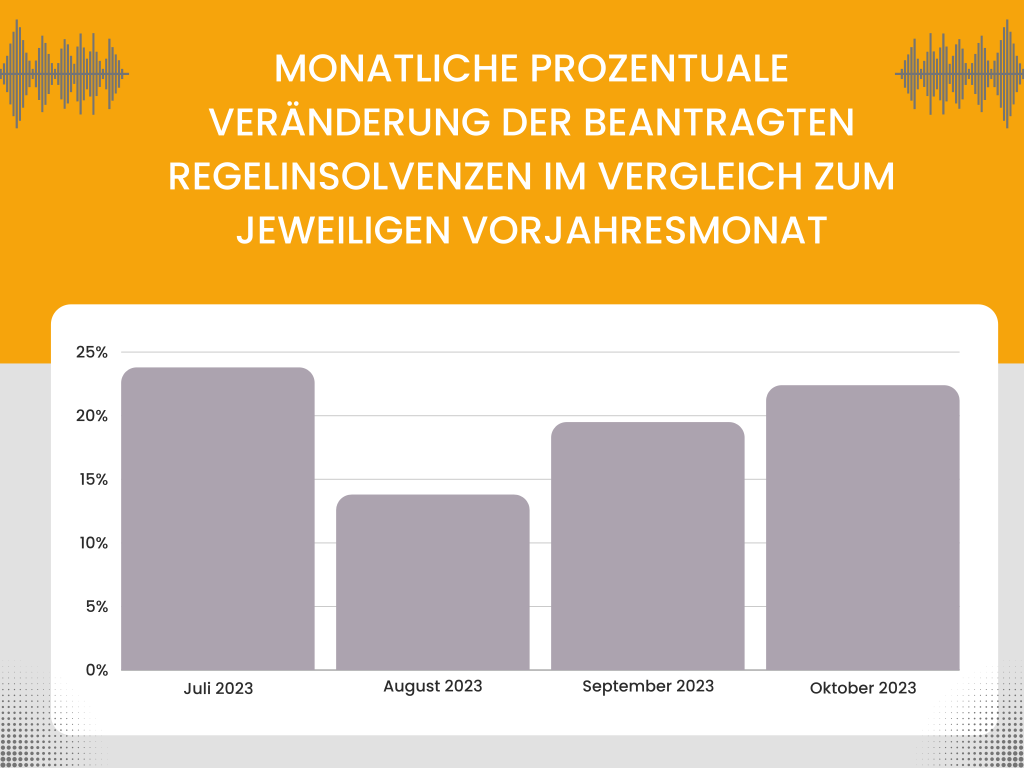
There has been a significant increase in company liquidations in Germany in recent months. According to data from the Federal Statistical Office, regular insolvency applications rose by 22.4% in October 2023 compared to the same month in the previous year, a trend that has continued at double-digit growth rates since June 2023. Larger companies are particularly affected, with an 11.4 % increase in business closures between January and September 2023. These developments reflect the increasing economic challenges that companies are facing in the current economic situation. This trend is an important indicator of change in the German corporate sector and underlines the importance of forward-looking corporate governance and effective crisis management strategies.
What does the liquidation of a GmbH or UG cost?
If you want to dissolve your GmbH or UG, you will have to expect some costs. How high these will be depends on the individual case. The costs for preparing the liquidation opening and closing balance sheet usually amount to several thousand euros. In addition, there are the notary's certification costs of around 250 euros. The notarial costs for the actual deletion of your company are around 100 to 150 euros. If your company is to be deleted due to a lack of assets, the costs for this amount to around 1,200 euros.
Dissolution and deletion of a GmbH/UG: The most important facts in brief
- The liquidation of a GmbH or UG is possible for many reasons - e.g. by resolution of the shareholders (Section 60 GmbHG)
- The liquidation process is divided into 3 phases: dissolution, liquidation and deletion
- One or more liquidators must be appointed for the liquidation
- The liquidators' duties include collecting existing claims, making outstanding payments to creditors and liquidating all assets
- Once the liquidation phase is completed and the GmbH/UG is deleted from the commercial register, the company's existence is terminated
Recht 24/7 was the only online law firm to receive the Focus Money “Highest Customer Satisfaction” seal for the fourth consecutive year Recht 24/7 2023, 2024, 2025, and 2026 . The online law firm Recht 24/7 founded in 2003 with the slogan “Law can be simple” and has since helped more than 100,000 satisfied clients with all legal matters. This is also evidenced by the “Very High Customer Trust” award from WirtschaftsWoche in October 2024.null
In the areas of trademark applications and start-ups, the firm filed the most applications in Germany in 2022 and 2021:
https://dev-recht24-7.de/dpma-markenanmeldung-mit-deutschlands-nummer-eins/